CHINA> National

|
CHINA> National
|
|
Govt may wait until after Games to boost oil prices
By Fu Jing (China Daily)
Updated: 2008-07-29 15:11 The government may not consider a further boosting of refined oil prices and pricing deregulation until the end of the Olympics in spite of the recent global drop in oil prices. Speaking to China Daily, experts and industry insiders said the government would not regard the fall in world oil prices as a "window opportunity" for action, following its oil price rise in June. But they all agreed that China's leadership had achieved the consensus of putting the refined oil prices at the hand of the market. "As far as I know, China's highest leadership has achieved the consensus of letting the market have final say on refined oil prices," said Lin Boqiang, energy professor at Xiamen University. "But they may not do so before the end of the Olympics." About 47 percent of China's oil demand has been currently satisfied by the international market. And China has linked its crude oil prices with the global market. But the government still controls refined oil amid a long-lasting debate over deregulation.
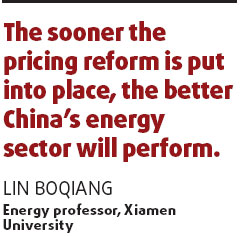
"But before the consensus turns into reality, the government will gradually boost the refined oil prices to bridge the gap with the international market," said Lin, director of the China center for energy economics research of the university. Despite the Olympics factor, Lin said the government could frown on an oil price hike and pricing deregulation, as China's inflation is still high. This month, China's leadership has readjusted its economic agenda to maintain higher growth and put inflation under control despite expected rises in the consumer price index (which is predicted to increase 6.1 percent during the third quarter, down 1.7 percentage points from the second quarter). "But as far I am concerned, the sooner the pricing reform is put into place, the better China's energy sector will perform," said Lin, adding that the government can save subsidies for the domestic crude oil refiners. Then, the government can put more effort in subsidizing those vulnerable groups whose basic living has been affected by higher energy expenditure. The contract dropped $2.23 to close at $123.26 on the New York Mercantile Exchange on Friday. Prices have eased recently while concerns mount over demand for oil in the face of prolonged weakness in the US economy, the world's biggest energy consumer. Oil prices broke through the $100 level at the start of the year and then rose to a series of record highs on concerns over supply. OPEC chief Chakib Khelil said Saturday that the price of oil could drop to between $70 and $80 a barrel if the US dollar strengthens and concerns over Iran are reduced. To gradually deregulate refined oil prices, the National Development and Reform Commission last month announced the price of gasoline and diesel would go up by 1,000 yuan per ton from June 20, and the price of aviation kerosene would increase by 1,500 yuan per ton. Before this round of price rises, the last time China adjusted gasoline and diesel prices was in November 2007, when the price of gasoline, diesel and aviation kerosene was raised by 500 yuan, or 9 percent, a ton. At that time the global crude price was around $90 per barrel. But the recent rise of refined oil price cannot fully offset domestic refiners' losses caused by surging crude prices. Analysts said the country's two leading oil companies, PetroChina and Sinopec, would continue to see losses in their refining business even after the price hike. Facing the situation, Zhang Shuguang, an economist with the Chinese Academy of Social Sciences, urged the government to further raise the prices of refined oil following the hike and finally reach the standard of the global market. "We should not subsidize the refiners and on the other hand, higher prices can promote saving culture," said Zhang, saying the higher fuel prices could help China realize its energy-saving goal of 20 percent between 2006 and 2010 per unit of GDP. |
兰坪| 彰武县| 苗栗县| 永清县| 侯马市| 军事| 永平县| 高州市| 长垣县| 营口市| 喀什市| 徐闻县| 舒兰市| 布尔津县| 甘肃省| 慈利县| 南城县| 达尔| 夏津县| 紫云| 枣庄市| 河北省| 喜德县| 沛县| 嘉黎县| 炎陵县| 阿克苏市| 荆门市| 玛曲县| 永泰县| 疏勒县| 孝义市| 金乡县| 噶尔县| 黎城县| 华安县| 龙门县| 宣威市| 景谷| 通化市| 浮梁县|