CHINA> Focus

|
CHINA> Focus
|
|
Bearing the brunt of globalization
By Shan Juan (China Daily)
Updated: 2008-07-03 07:36
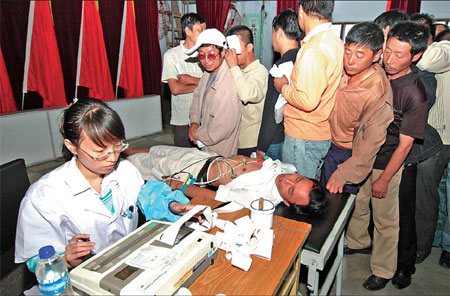
Last year, more than 20 workers at a factory in Wuxi, Jiangsu province that produces nickel-cadmium batteries for electronic products giant Panasonic were found to be suffering from high levels of cadmium, a toxic and cancer-causing chemical. Two of the workers were diagnosed to be suffering from cadmium poisoning, an affliction high on health authorities' danger list of occupational diseases. Such poisoning is said to be able to cause kidney failure, lung cancer and bone disease. "For the safety of workers and environmental protection, this kind of battery, which is cheap to produce and safe to use but hazardous to make, has been barred from production in Japan and other developed countries," said Li Tao, director of the National Institute Of Occupational Health and Poison Control under the Chinese Center for Disease Control and Prevention. "Now the batteries are largely made in China, and the industry is causing illnesses among workers and poisoning the soil and water," Li said. Accounting for 3 percent of total battery sales worldwide, the nickel-cadmium batteries are reportedly still widely used in toys, wireless phones and other electronic goods sold in several developed countries, even though the European Union has banned sales of the battery. "The production was outsourced to China because no one in the United States wanted to deal with the waste from cadmium," said Josef Daniel-Ivad, vice-president for research and development at US-based battery company Pure Energy Visions. The cadmium poisoning in Wuxi is one example of how China and its factory workers are faced with health and environmental challenges from industries transferred from developed countries, that in turn help fuel the country's economic growth amid increasing globalization. Cases of outsourced industries that harm the health of Chinese workers are not uncommon, Li said. Of the 758 million workers from the country's 16 million industrial enterprises, nearly 200 million come into contact with various work-related hazards, figures from the Ministry of Health showed. By the end of 2006, there were 676,562 reported cases of people suffering from occupational diseases, which incurred annual economic losses of 300 billion yuan ($43.8 billion). Another instance of workers facing health hazards from industries outsourced from abroad is the tatami-producing industry. Tatami is a mat produced from a grass-like plant that is used widely as floor coverings in Japan. The industry has shifted to China and a number of other countries in Southeast Asia, with Ningbo, Zhejiang province, making 70 percent of the tatami mats sold in Japan, Li said. Ningbo generates about 1.2 billion yuan ($173 million) from the tatami business every year, with most of the mats being exported to Japan, Li said. During the production process, workers are said to be exposed to a clay dye dust known as "sendo", which is used to prevent fading of the mat color and to strengthen it. "The dust contains 20 to 30 percent of free silica and is therefore a potential cause of pneumoconiosis, commonly known as the incurable black lung disease, when workers inhale the dust and toxic material," Li said. The black lung disease takes up more than 70 percent of reported cases of occupational health and has killed 146,195 people, Health Ministry figures showed. Nationwide, there have been 10,000 new cases of pneumoconiosis reported every year for the past 15 years, mostly in the mining and manufacturing industries. "My lung is damaged and has been treated twice," said Chen Qilun, 47, a migrant worker from Zhongxian county in Chongqing municipality, who was diagnosed with pneumoconiosis while working in Ningbo in 2002. Chen was one of the 163 pneumoconiosis patients screened out that year, among 9,000 workers making tatami in the eastern port city, the local health authority said. "I cannot work any more. My lungs would hurt whenever I try to lift up a heavy object," Chen said. Apart from paying for his son's university tuition, all his savings have been spent on medical bills. "I earned the money at the cost of my health and life but I was kept totally in the dark about the risks," he said. "For innocent and poor people like Chen, they make money at the cost of their health in the beginning and later use the money to buy time to live," Li said. Currently, the central government has no clear-cut regulations on the admittance of overseas industries, Xie Liangmin, deputy director of the All China Federation of Trade Unions, told China Daily. Driven by the desire for quick profits, a number of local governments bring in factories that cause heavy pollution and harm workers' health, Xie said. Some of these deal in industries that were long discarded in their home countries, he said. "These pose grave health challenges to workers and the environment, incurring heavier economic losses than gains," Xie said. When introducing industries and enterprises outsourced from overseas, local authorities should first consider the safety of both the environment and the workers in the long term, he said. Currently, there are laws on occupational disease prevention and environment protection that require enterprises to follow strict guidelines on the safety of workers and environmental protection. The government has also set standards on work safety that include taking into account hazardous chemical exposure, which are in line with those endorsed by the World Health Organization. Similarly, government-backed occupational-disease hospitals have been set up nationwide to facilitate check-ups on occupational health. However, experts say more needs to be done to enhance law enforcement in these areas. "The team overseeing enterprises on occupational safety protection is poorly staffed," Xie said. He cited Shenzhen as an example, where there are only a dozen officials inspecting tens of thousands of enterprises in the southern boomtown on work-related health risks. Workers facing such risks have also been encouraged to seek help from trade unions to better safeguard their rights, he said. The authorities have taken other measures to help workers, said Su Zhi, deputy director of the health supervision bureau under the Ministry of Health. The employers are currently required to provide free pre-job, on-job, and pre-departure health examinations for their workers, he said. "That would help with early diagnosis and treatment of occupational diseases," Su said. Industries with work-related hazards should also have strict monitoring systems in place to supervise work safety, he said. "However, only a fifth of them presently fulfill their responsibilities to evaluate worksite health risks," Li Tao from the National Institute Of Occupational Health and Poison Control said. "It's mainly because of poor surveillance and lax enforcement of the law by the authorities," Su added. For example, health authorities require companies to pass workplace hazard evaluation tests before and during the work process, but other departments do not make it a precondition for their approvals, he said. "The lack of awareness of occupational health and poor coordination among different governmental agencies are partly to blame," Su said. |
白银市| 攀枝花市| 霍州市| 衡东县| 松滋市| 宜阳县| 奉化市| 兴安盟| 略阳县| 贵港市| 庆元县| 灵寿县| 眉山市| 宿州市| 房产| 天全县| 济宁市| 通州区| 册亨县| 泰安市| 沙田区| 西峡县| 融水| 韶山市| 宜兰县| 茌平县| 博客| 西峡县| 阜康市| 南阳市| 宜兰市| 无为县| 余庆县| 兴隆县| 鄱阳县| 博乐市| 梨树县| 开封县| 黑水县| 积石山| 延寿县|