CHINA> National

|
CHINA> National
|
|
Plunging supplies lessen threat of traditional narcotics
By Zhu Zhe in Beijing and Zheng Caixiong in Shenzhen (China Daily)
Updated: 2008-06-26 07:01 Traditional drugs such as heroin are posing less of a threat to China, due to a sharp drop in poppy cultivation from the Golden Triangle region and stricter border control, a senior police officer said on Wednesday. "The amount of drugs entering China from the Golden Triangle region has fallen in recent years," Yang Fengrui, director of the anti-drug bureau of the Ministry of Public Security, told a news briefing organized by the State Council Information Office. Yang said a major reason for the decline is the drop in opium cultivation in the Golden Triangle, the infamous drug-producing region that overlaps the mountains of Myanmar, Laos, Vietnam and Thailand. 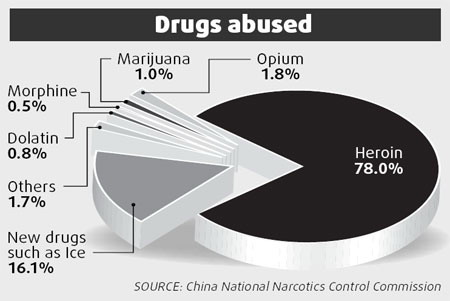 He said opium cultivation in Myanmar has dropped from 165,300 hectares at a peak of several years ago to a record-low of 18,600 hectares. In Laos, opium cultivation has been almost eliminated. Intensified police checks at borders and the use of advanced drug detectors are also behind the drop, Yang said. Consequently, less drugs are being seized in China. Figures released yesterday showed that Chinese police seized 4.6 tons of heroin last year, down about 20 percent year-on-year. The amount of opium seized also dropped from 1.7 tons in 2006 to last year's 1.2 tons. The change has caused a tight supply of heroin and opium in the illicit drug market, pushing up prices. The average daily cost of heroin for drug abusers in China has increased from 218 yuan ($32) in 2004 to the current 320 yuan, ministry figures showed, while the purity of heroin sold in small packages has fallen sharply. The annual growth rate of heroin users in the country has also dropped from a peak of 30 percent years ago to the current 5.6 percent. Similarly, the proportion of AIDS/HIV infections spread by intravenous drug use has decreased from 68.7 percent in 2001 to 38.5 percent currently, ministry figures showed. Still, Yang said the battle is far from over, with drugs from abroad entering China in large volumes while domestic production grows. He said China will continue to cooperate with Myanmar and other countries by exchanging intelligence, fighting drug traffickers, eradicating drugs, training personnel and helping the Myanmar government with crop substitution programs. Over the past few years, China has invested about 700 million yuan on the substitution programs in Myanmar and Laos, offering 100,000 tons of food and medical aid to people who have stopped farming opium in the regions. As part of the battle against the drugs, Shenzhen police publicly burnt more than 2,759 kg of drugs on Tuesday. In a recent case, local customs in Shenzhen revealed a major drug smuggling case involving the seizure of 113.7 kg of ketamine. Stocks of marijuana, Ice and cocaine, as well as 3 million yuan in cash, were seized in the crackdown launched by local authorities in late April, the Guangzhou Daily reported. |
札达县| 灌阳县| 长沙县| 全州县| 内江市| 南雄市| 平舆县| 奉化市| 兴和县| 西青区| 昭苏县| 雷波县| 江陵县| 塔河县| 喀喇| 曲水县| 神农架林区| 佛坪县| 四川省| 天台县| 且末县| 芦溪县| 临西县| 普格县| 永丰县| 酒泉市| 博兴县| 克拉玛依市| 库车县| 义马市| 玛多县| 临清市| 台中市| 濉溪县| 龙陵县| 洮南市| 大渡口区| 西乌珠穆沁旗| 岚皋县| 闸北区| 禹城市|
