CHINA> Regional

|
CHINA> Regional
|
|
Student eyesight problems on rise
By Cao Li (China Daily)
Updated: 2008-06-19 08:55 SHANGHAI: About half of this city's 1.2 million primary and high school students suffer from various eye diseases.
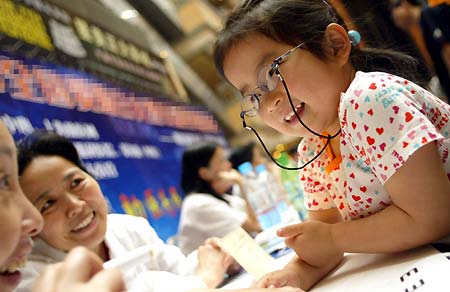
A recent survey by the Shanghai Municipal Center for Eye Disease Prevention and Treatment covering about 5,000 students found that 51 percent of primary and high school students were either nearsighted, farsighted, or were suffering from tired or misaligned eyes, or other inherited conditions. More than 92 percent were myopic. The percentage of students suffering from vision problems rises as they progress up the school grades in a competitive schooling system. More than 28 percent of primary school children have vision problems, Zhu Jianfeng, director of the center, said. The percentage doubles as they enter junior high, to 62 percent. And at the 11th grade, when they are preparing for the college entrance examination, 87 percent have bad vision, most of them suffering from nearsightedness, he said. Reading at close distance for a long time, watching too much TV, and playing computer games, while doing little or no outdoor exercise, is contributing to the problem, the survey said. Improper lighting in classrooms is also a major cause. Cong Haiying, an official with the Shanghai municipal education committee, said students spend most of their time in the classroom. The committee is working with the city health department and the Center for Eye Disease Prevention and Treatment to improve lighting in all 45,000 classrooms in Shanghai. In 2006, lighting in some classrooms was improved and the eyesight of students monitored. "It showed an improvement," Cong said. The lighting in one-third of classrooms in primary and high schools will be improved this year. And by 2010, all of them will be brighter and the percentage of bad vision is expected to drop. "We are going to hire experts to lecture parents and students on how to maintain good eyesight," Cong said. Zhang Lei, of the New Vision Eye Clinic at Ruijin Hospital, said improved lighting will help, but not much. The situation will not improve if students continue to be burdened with a lot of homework and extra lessons, he said. "If improved lighting works, children today should have better eyesight that those of 50 years ago. But it is the opposite" Zhang said. Genetically, Asian people tend to suffer from nearsightedness, he said. "Myopia develops slowly in healthy bodies, but most Chinese students seldom spend much time outdoors. "If it is impossible to ease the workload, but it would help to have regular eye checks, and rest the eyes as often as possible," Zhang said. |
彰化县| 望城县| 濮阳县| 平邑县| 沂南县| 庄河市| 曲麻莱县| 舟曲县| 双桥区| 博兴县| 绥中县| 富宁县| 阳谷县| 西贡区| 商水县| 定兴县| 沾益县| 龙井市| 临洮县| 蚌埠市| 大姚县| 大庆市| 湄潭县| 忻州市| 惠东县| 正定县| 成武县| 泸水县| 商都县| 蕲春县| 墨竹工卡县| 中宁县| 多伦县| 莒南县| 大新县| 温泉县| 吕梁市| 都昌县| 普宁市| 拉萨市| 双城市|