
Bye to plastic bag full of trouble
Updated: 2008-06-02 07:45
Want a plastic shopping bag? Pay for it. That's what shoppers were told at cash counters of supermarkets, department stores and groceries across the country Sunday.
Following a government order aimed at reducing pollution, retailers stopped giving free plastic shopping bags from Sunday.
|
|
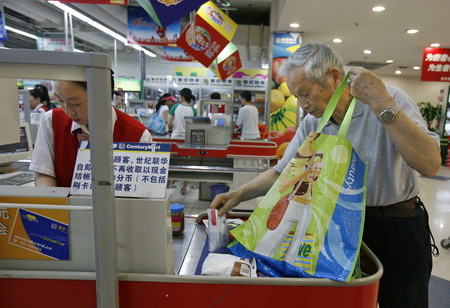
Plastic shopping bags undoubtedly make shopping convenient, but they also harm the environment.
According to the National Development and Reform Commission (NDRC), at least 1,300 tons of oil is needed to make the bags given out by supermarkets alone every day.
"Plastic bags are not bio-degradable," Men Xiaowei, a Ministry of Commerce official, said in an online interview. "And plastic accounts for 3-5 percent of the daily waste, most of which come from plastic bags."
That's why "customers have been urged to carry their own bags," he said. "To limit the use of plastic bags is to protect the environment."
The government has banned ultra-thin or thinner than 0.025 mm plastic bags too because the thinner the plastic sheet the more harmful it is to the environment.
But the question is: Can the Chinese people, who have enjoyed free plastic bags for more than a decade, kick their habit? And what do the vendors think?
"It doesn't matter how much a plastic bag costs. What matters is our effort to protect the environment," Wang Yali said while packing grocery into a cloth bag.
A woman surnamed Wang, shopping at Jian-Mart, said: "I will carry my own bag and use plastic bags only when I really need them."
"I don't think 0.2 yuan for a bag is too high," said another shopper. "I will carry a cloth bag when I go to the market. Only when I have lots of things to buy like today, I wouldn't mind buying one or two plastic bags."
But Wang Jingnian, a vegetable vendor said he would keep offering free bags because "0.2 yuan is an insignificant amount and I don't mind giving free bags to my customers, for vegetables are not suitable to be kept in cloth bags."
Many customers, too, think plastic bags are a necessity, and an absolute ban will be hard for them to follow. "I have to use plastic bags, especially for fresh meat and vegetables, and I think 0.1 yuan for a bag is acceptable," a woman surnamed Ye said.
Retailers have begun charging 0.2 yuan (3 US cents) for small plastic bags and more than 10 yuan for the ones made of cloth. Supermarkets such as Wal-Mart, Carrefour and Jian-Mart have set up green channels, too, for shoppers carrying their own bags.
Shopkeepers are free to set their own prices for the plastic bags but they should not be cheaper than their cost. "Some retailers are worried that they may lose their customers if they charge too much for the bags," Men said. "But our goal is to reduce the use of plastic bags."
The State Administration for Industry and Commerce (SAIC) said retailers who continue to provide free plastic bags would be fined between 5,000 yuan and 10,000 yuan.
The SAIC started a special campaign Sunday to monitor the sale of plastic bags. "Department stores, supermarkets, groceries and plastic bag retailers will be under special watch during the campaign," the SAIC said.
A Social Survey Institute of China study, covering 1,000 people in 10 major cities including Beijing, Shanghai and Guangzhou, shows 69.2 percent think the ban will have limited impact on environmental protection because many people will continue using plastic bags.
Ma Fengluan, a plastic bag wholesaler, said medium-sized, ultra-thin plastic bags good enough to carry 6 kg cost 0.06 yuan each. A thicker one of the same size cost 0.15 yuan, and the difference is too little to be noticed by customers.
Adjusting to a life without plastic bags will be a problem for some people, experts said. But if customers change their habit, and pick up cloth bags again, the environment could be spared a little.
The ban poses a challenge to plastic bag manufacturers too. About 60,000 plants in the country make plastic bags, with Guangdong province alone accounting for 10,000 of them.
|
||
|
||
|
|
|
|