
Cultural relics lost to earthquake
Updated: 2008-05-23 07:24
CHENGDU - Sixty-five cultural relics under state protection and 119 under provincial protection in Sichuan province have been severely damaged as a result of last Monday's earthquake, the State Administration of Cultural Heritage said this week.
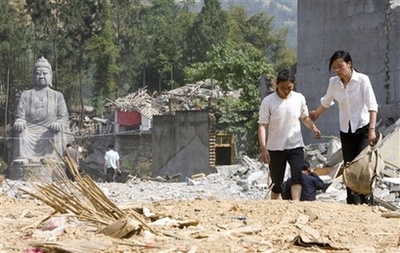 Residents walk near a statue of Buddha next to buildings destroyed after Monday's earthquake in Guanzhuang, southwestern China's Sichuan province, Sunday, May 18, 2008. [Agencies] |
Expert teams will be sent to Sichuan to appraise the damage and advise on the best course of action, the administration's director Shan Jixiang said.
Shan arrived on Monday in Chengdu, the provincial capital, where he chaired a disaster relief conference the following day.
The conference heard that many ancient buildings in Sichuan have collapsed or are on the brink of collapse. A total of 841 museum relics, 148 of which were regarded as precious, have been ruined.
The Erwang Temple and Mount Qingcheng in Dujiangyan, and the Bao'en Temple in Pingwu county were among the worst hit.
The Erwang Temple, which translates as "Temple of Two Kings", was built 2,000 years ago to honor Li Bing, the then governor of Sichuan governor, and his son for their contribution to the construction of Dujiangyan, the world's oldest irrigation project still in operation. It collapsed in the quake.
At Mount Qingcheng, the birthplace of Taoism, China's only indigenous religion, several ancient buildings are listing and in danger of collapsing, Wang Qiong, deputy chief of the Sichuan bureau of cultural heritage, said.
Like the Dujiangyan irrigation project, which was built around 256 BC, Mount Qingcheng is on the United Nations' World Heritage List.
The Bao'en Temple, built by Pingwu governor Wang Xi between 1,440 and 1,460, is one of the largest Buddhist temples in Sichuan, measuring 278 m by 100 m.
The monastic complex was known for its glazed roof tiles, similar to those found at the Imperial City in Beijing.
To show his gratitude to the emperor for allowing him to build such a large temple, Wang Xi named it "Bao'en", which means, "paying a debt of gratitude".
Wang Qiong said many of the temple's walls have collapsed and its fresco has been ruined.
Despite Chengdu being 92 km from the epicenter, the roofs of some buildings at the city's Du Fu Thatched Cottage Museum were broken and some walls have cracked.
The museum is dedicated to Du Fu, one of China's greatest poets, who wrote 240 poems while living in Chengdu.
Sichuan's cultural bureau has asked museums across the province to temporarily store their exhibits to ensure their safety, Wang Qiong said.
|
||
|
||
|
|
|
|