
Algae threatens drinking water for 320,000
Updated: 2008-05-04 22:33
HEFEI -- Blue-green algae has been discovered in Chaohu Lake, which is China's fifth largest body of fresh water and the drinking water source for about 320,000 people, an environmental official said.
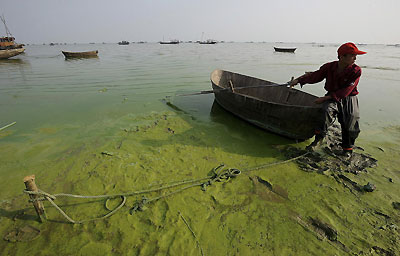 A fisherman pulls a boat at the algae-filled Chaohu Lake in Hefei, Anhui province, May 1, 2008. [Agencies] |
The lake in Anhui Province has been severely polluted in recent months.
Following a long stretch of hot, dry weather, patches of algae were found in the western part of the lake, and traces of algae also cropped up in the eastern part, said Xiao Pu of the Anhui environmental protection bureau. Xiao said the lake supplies drinking water to about 320,000 people on its eastern banks,
"Normally, algae need a proper proportion of nitrogen and phosphorus, continuous temperatures above 25 degrees centigrade and strong sunlight for at least three days," to thrive, Xiao said. "Although there are no signs of a massive bloom of algae in the lake, current conditions are conducive to algae growth."
Xiao attributed the situation to the heavy snowfalls early this year. "When the snow melted, the water carried fertilizers and other nutrient runoffs to the lake, bringing the volume of nitrogen and phosphorus to a higher level."
The provincial environmental authority has ordered local environmental officials to enhance monitoring of the lake and plan for alternative water supplies.
Chaohu Lake, which covers 13,000 square kilometers, became increasingly polluted after nearby cities industrialized and the wetland was destroyed.
From June to August last year, nutrient runoffs and other pollutants caused blue-green algae blooms in Taihu, Chaohu and Dianchi lakes, endangering water supplies for nearby cities and threatening aquatic life.
The worst algae outbreak was in the eastern Taihu Lake, the country's third largest freshwater lake, and it rendered tap water undrinkable for about 10 days for more than 1 million people in Wuxi, Jiangsu Province.
Blue-green algae occurs naturally in rivers, lakes, damp soil, tree trunks and hot springs.
Meanwhile, the China Meteorological Administration said on Sunday that both the frequency and area of algae appearance were down in April, thanks to pollution control efforts.
Satellite monitoring showed that last month the frequency and area of blue algae appearance in the lake were 64 percent and 44 percent of the level a year ago.
The lake's water quality in the first three months was basically at the same level as that in the same period last year, according to the Taihu Basin Authority.
Early reports said scattered swathes of blue-green algae had been found in some southern parts of the lake, which supplied water to about 30 million people, arousing new concerns about a algae bloom.
|
||
|
||

|
|
|
|