
Green official 'luckiest' in China
Updated: 2008-04-25 07:21
LHASA: If you want to hear about the woes of environmental protection officials battling against local leaders driven by GDP growth, forget about Zhang Yongze.
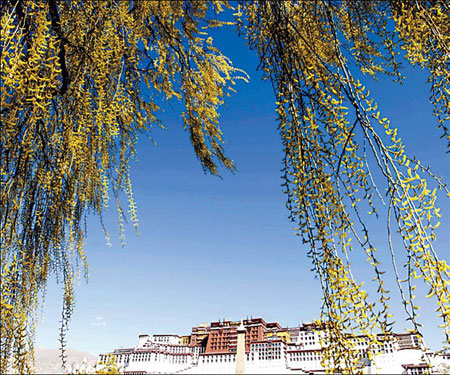 Green trees and blue skies such as these near the Potala Palace are a common sight in Lhasa these days. In recent years, the central and local government have spent billions of yuan to clean up the environment in Tibet. [Xinhua] |
The director of the environmental protection bureau of the Tibet autonomous region has a very different story to tell.
Across China, environmental watchdogs have a difficult time dealing with local administrators preoccupied with boosting growth indices. They sometimes have to risk offending the latter and being sidelined, or shut up and move elsewhere.
But that has never happened to Zhang, he said.
"I feel really fortunate and proud being in this position," he told China Daily.
His pride is based not only on the fact that Tibet has one of the world's best-preserved ecosystems, but also that it has only once experienced bad pollution.
That was on March 14, when sulfur dioxide and nitrogen dioxide levels in the air around Lhasa were more than twice the average, according to figures from the local environmental department.
"Actually, environmental conditions here have been improving over the years," Zhang said.
Zhang, who got his PhD in water pollution control from Sichuan University in 1997, and volunteered to leave the Beijing-based Chinese Research Academy of Environmental Sciences for Lhasa the next year under the national Aid-Tibet program, has plenty of numbers to illustrate his claim.
In the 1950s, forest coverage in Tibet was less than 1 percent; now it is more than 11 percent, he said.
Thanks to increased vegetation, there has been a dramatic drop in the number of dusty days. For example, 30 years ago, Lhasa used to get 32 more dusty days a year than it does now, he said.
In addition the regional government has also been developing alternative energies and examples are "omnipresent" throughout Tibet, he said.
From the residential communities of downtown Lhasa to remote homes in the countryside, solar stoves and power-generating units can be seen in use. Windmills can even be spotted in some parts of Nagqu, he said.
Furthermore, local authorities have built 14,800 methane-producing facilities to provide clean energy for more than 70,000 farmers and herdsmen, he said.
"Alternative energies have greatly facilitated the protection of the natural vegetation in agricultural and pastoral areas," Zhang said.
Tibet's 40 nature reserves account for more 34 percent of the region's territory, he said.
"There is no match anywhere in the country. The national average is about 15 percent," he said.
Zhang said he is accustomed to being the envy of his counterparts both within and outside the region.
"I hear them saying jealously to me that 'you are the luckiest'," he said.
"And I totally agree."
To illustrate what he called a "high-profile consensus" on building Tibet into an ecological protective screen for the country, Zhang quoted the region's top official.
"Chairman Qiangba Puncog has a well-known saying that goes 'We should not accept any project that compromises our environment, even if it is digging for gold'," Zhang said.


|
||
|
||
|
|
|
|