
Stable forex policy urged as yuan sets new mark against dollar
Updated: 2008-04-10 21:11
China should adopt a stable foreign exchange rate policy to avert the possible economic fall-out of continued yuan appreciation, policy advisers said on Thursday, as the currency broke through the 7 mark against the US dollar.
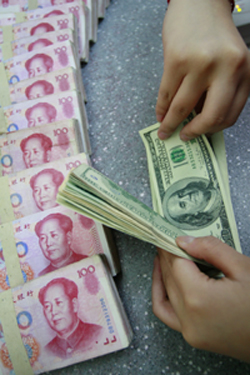 A bank teller counts the stack of Chinese yuan and US dollars at a bank in Sichuan, April 10, 2008. [Xinhua] |
Neither a sharp one-off appreciation nor major fluctuations were desirable, said Fan Gang, Monetary Policy Committee member of the central bank, the People's Bank of China (PBOC).
The yuan, or Renminbi (RMB), was set by the PBOC to trade at a central parity rate of 6.992 per dollar on Thursday, the first time since July 2005 (when the dollar peg was dropped) when it fell below 7. Since the peg was abandoned, the yuan has risen 15.99 percent against the dollar. So far this year alone, it has risen 4.47 percent as the dollar has continued to weaken.
The rate of 7 per dollar was a key point for China to safeguard its financial interests and worth "serious deliberation", said Tan Yalin, a researcher in the global financial markets department of the Bank of China.
Overly rapid appreciation would pose a risk to China's double-digit economic growth, a large part of which had been driven by exports, said Cai Ruhai of the Central University of Finance and Economics.
Major trading partners such as the United States have pushed for the yuan's appreciation, arguing that an undervalued currency made Chinese goods artificially cheap and caused it to run a huge trade surplus.
The RMB was already rising fast enough and China should first guarantee the stability of employment and economic order, said researcher Mei Xinyu at the Chinese Academy of International Trade and Economic Cooperation, a division of the Ministry of Commerce.
As export growth has slowed and import growth has picked up, the trade picture has begun to shift. For example, the trade surplus fell to US$ 8.56 billion in February, roughly one-third of that a year earlier.
How long that trend will persist is unclear. Analysts said the fall was mainly caused by China's severe winter, which affected the production and transportation of exports, and weaker US demand amid the ongoing credit crisis. However, faster currency appreciation was also exerting pressure on exporters.
China will keep the yuan basically stable at a reasonable, balanced level, the PBOC's monetary policy advisers told a conference last week.
China needed a relatively stable forex policy to protect itself from speculative fund flows when the world economy was facing uncertainties such as the spreading credit crisis, said Fan.


|
||
|
||
|
|
|
|