DNA sampling used to save tigers
Updated: 2008-02-16 11:56
Siberian tigers kept at a reserve in Harbin, the provincial capital of Heilongjiang, are being given a dose of selective breeding to prevent genetic degeneration of the species, park officials have said.
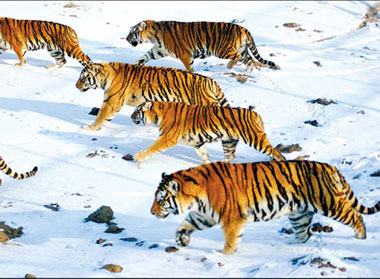 Big cats roam the snow-covered Siberian Tiger Park in Harbin, Heilongjiang Province, in this file photo. The park, which breeds the endangered beasts, is facing financial difficulties. [China Daily] |
"We will choose 50 tigers for breeding according to DNA test results," Liu Dan, chief keeper at the Siberian Tiger Park, said.
Over recent years, the park has conducted DNA sampling on all tigers over a year old to prevent "inbreeding" and reduce the genetic degeneration of the species, Liu said.
"The ultimate goal is to build a family tree for them, so as to guarantee the pure blood of the species and prevent genetic degeneration," he said.
Founded in 1986, the Harbin-based park is one of the nation's largest Siberian tiger breeding bases, with more than 800 of the animals.
Besides inbreeding concerns, the park also wants to rein in the population of the big cats.
After two decades, the center has seen successes in breeding the tigers, with their numbers increasing from just eight at the start of the breeding program to more than 800 currently.
But the population explosion has led to a different challenge - feeding the beasts.
The cost of food and medical care for one tiger has been put at about 30,000 yuan ($42,000) a year.
This means the park has to spend more than 20 million yuan a year on its tigers, sources familiar with the park's operations said.
The park receives only limited income from ticket sales and government funding, officials said.
"This is far from enough," Wang Ligang, the park's general manger said, adding that the gap is widening every year.
Wang urged the government to lift the ban on tiger trade to ease the financial burden.
"The trade of bones from tigers that are bred in captivity and subsequently die of natural causes will not affect the conservation of wild tigers. This can help raise funds for living tigers and also provide relief to patients," he said.
In Chinese medicine, tiger parts are used as cures for illnesses ranging from colds to rheumatism.
China joined the Convention on International Trade in Endangered Species of Wild Fauna and Flora in 1981 and imposed a ban on the harvesting of tiger bones in 1993, starting a long-running debate between proponents of the trade and conservationists.
A recent poll conducted by the Save the Tiger Fund showed almost 95 percent of respondents in seven major cities supported the ban, according to the Xinhua News Agency.
Siberian tigers, which are among the world's 10 most endangered species, mostly live in northeast China and the far east region of Russia.
Of the 400 tigers estimated to be in the wild, only 10 to 17 are said to live in Northeast China.
|
|
|
||
|
||
|
|
|
|