China taking 'right steps' to protect IPR
Updated: 2008-01-29 07:31
China is taking the right steps to prevent intellectual property rights (IPR) violations, though it needs more time to achieve progress.
This is what European Union (EU) Tax and Customs Commissioner Laszlo Kovacs said in Beijing Monday.
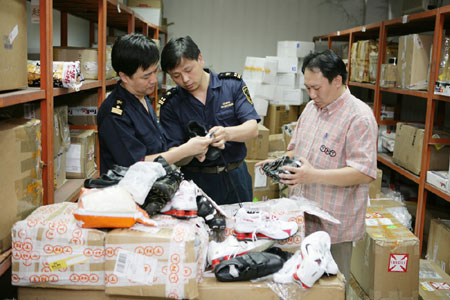 Customs officers in Beijing inspect shoes exported by a Chinese trading company in August 2006. The company's products have come under special inspection after it was found to be exporting imitation Nike shoes. [China Daily] |
It's true that 80 percent of the counterfeit goods seized on EU borders in 2006 came from China. And it's true too that IPR protection is a major issue for EU businesses.
But Kovacs said the Chinese government is taking proper legislative steps to stem the flow of counterfeits both at home and abroad.
"We have already witnessed a decrease (in counterfeit goods from China)," he said. "I do hope that not in the long but in the medium term there will be some progress so that the proportion from China will decrease (further).
"In 2006 and 2007 several persons were taken to court in China, who were manufacturers of counterfeit articles and landowners who operated markets where counterfeit goods were sold. So that shows China takes it (the problem) seriously."
China has made welcome progress in setting up an IPR protection mechanism, he said. There have been visible improvements in enforcement, and the Chinese Customs legislation is now quite similar to that of the EU.
Kovacs, however, said the country still needs to take some extra steps such as establishing stronger administrative cooperation between the Customs in the EU and China.
That would lead to better enforcement of laws. Also, it would be a visible sign at the EU's willingness of the political level to support China's efforts in this field.
According to the Organization for Economic Cooperation and Development (OECD), pirated consumer products account for $200 billion a year, equivalent to 2 percent of the world's total trade.
Counterfeiting is an alarming and threatening phenomenon that gives rise to new trends, he said. Its compositions are changing, encompassing more products, from pharmaceuticals to toys.
Counterfeits and pirated products are a violation of IPR, causing losses of revenue, he said. Therefore, it has become a dual challenge.
Businesspersons hope to have smooth procedures to raise their competitiveness, while people want a tighter security and control over counterfeits to avoid safety and health hazards.
The challenge is to overcome these obstacles and establish rapid and smooth control, which requires cooperation and larger and advanced facilities.
Kovacs' meeting with Mu Xinsheng, minister of the General Administration of Customs, Monday was aimed exactly at solving these problems.
They agreed to develop the concrete action plan on IPR that began three months ago, which includes a partnership between the private sectors in China and the EU.
Given that the action has just begun, it is too early to assess whether trade facilitation and security have increased, Kovacs said.
Discussions at high political levels, however, are needed for in-depth dialogue with Chinese authorities and to ensure that operational success can be achieved, he said.
"We've agreed, on the level of intention, to widen the scope of the project, for instance, to involve the port of HK, and more European ports."
Kovacs said the project could be strengthened if it is expanded to cover mutual recognition of security standards and controls.
The pilot action plan began in December 2006, with the launch of secure and smart trade lanes.
Last November, the Customs of the UK, the Netherlands and China for the first time exchanged electronic information on sea containers leaving their territory through the ports of Rotterdam, Felixstowe and Shenzhen. The South China city is part of Kovacs' itinerary during this trip.
The purpose of the action plan is to better target counterfeit trade by:
* Exchanging pre-arrival/departure data on containers loaded on vessels leaving their territory among Customs;
* Using electronic seals on containers to ensure a secure end-to-end supply chain;
* Applying minimum control standards on containers and communicating the control results electronically;
* Defining common risk indicators to help select "high risk" containers for controls;
* Reducing overall controls on imports through recognition of controls on exports, thereby ensuring that any remaining import controls focus on particularly high-risk items.
The US, too, has expressed displeasure with China over counterfeits. But Kovacs said China and the EU agree on a point to differ with the US: a law requiring foreign ports to scan every sea container headed to the US.
Such a law would be costly to implement, generate a false sense of security and cause huge trade problems if it takes effect from 2012, as scheduled, he said.
|
|
|
||
|
||
|
|
|
|