Beijing not to curb rising population
Updated: 2008-01-25 08:14
Beijing will not impose compulsory measures to curb the rapidly rising population, despite it reaching the 16 million mark two years ahead of schedule, senior officials said yesterday.
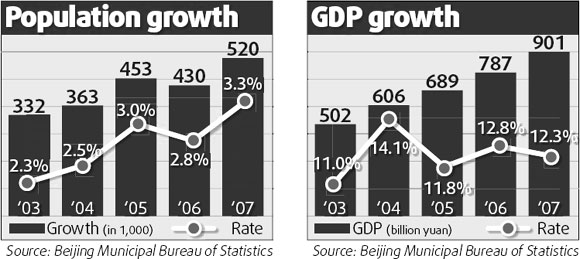 |
Figures released yesterday by the Beijing statistics bureau show the number of residents in the capital was 16.33 million at the end of last year, including 12.13 million with hukou (household registration) and about 4.2 million migrant workers.
Yu Xiuqin, a spokeswoman for the bureau, said the population was predicted to reach 16 million by 2010.
Last year's total was up 520,000 on 2006, the biggest annual increase in six years.
"This year, we will still face the pressures of a growing population," she said, adding that the city government had predicted the number to hit 18 million by 2020.
Wang Haiping, deputy director of the municipal development and reform commission, said Beijing had become a magnet for migrant workers because of its plentiful work opportunities.
The city's Acting Mayor Guo Jinlong said this week the "resource and environmental problems" created by the soaring population were among its "most pressing issues".
However, Wang made it clear at yesterday's press conference the government "will not impose compulsory administrative measures to prevent people from entering".
"That is an out-of-date approach," he said.
"Instead, we'll look to develop the city's vast suburbs and countryside to attract more migrants there."
In response to a question about whether the economy in Beijing will fall into recession after the Olympics, as has happened in other host cities, Wang said the so-called "post-Olympics" phenomenon will not affect Beijing.
He said a comprehensive study had concluded the economy will remain healthy and stable after the Games.
"Different from other cities that have experienced such a phenomenon, Beijing will have a new economic driving force in its rapid developing suburbs and countryside," Wang said.
Growing consumption and a booming national economy are also major supportive factors, he added.
Zhang Gong, director of the municipal development and reform commission, said this week the government will strike a balance between investments before and after the Games to prevent economic decline.
Beijing has forecast 9 percent annual economic growth over the next five years, with per capita GDP expected to grow from the current $7,000 to $10,000 over the same period, according to the city's government report released on Sunday.
In the past five years, the city saw annual growth of 12 percent.
Possible inflation
Yu with the Beijing statistics bureau yesterday also warned of possible inflation in the capital this year.
The CPI (consumer price index) in Beijing rose 2.4 percent last year, about half the national average.
The government's work report plans to limit CPI growth in Beijing to within 3.5 percent by the end of the year.
But with prices continuing to soar nationwide and labor costs also rising, Yu said the city faces a "stern" task.
|
|
|
||
|
||
|
|
|
|