Confucianism -- teachings of Confucius
Updated: 2007-12-25 11:14
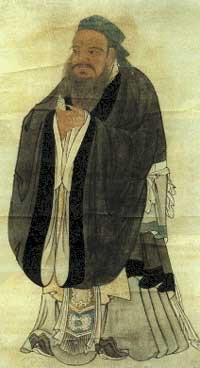 |
Confucianism became a major system of thought in Ancient China, developed from the teachings of Confucius and his disciples, and concerned with the principles of good conduct, practical wisdom, and proper social relationships. Throughout the feudal societies, it almost became dominant thinking. Confucianism has to some extent influenced the Chinese attitude toward life, set the patterns of living and standards of social value. Its legacy and beliefs spread from China to Korea, Japan, Vietnam and other Asian nations.
While some Western scholars take it for a Chinese religious thinking, it is actually only a philosophy.
Its founder, Confucius, or K'ung-tze, or K'ung-Qiu, was born in 551 B.C., in what was then the feudal state of Lu, now included in the modern province of Shandong. Confucius was only three when his father died. From childhood he showed a great aptitude for study and became very learned. In the past, education was the privilege of the rich and the nobles, but Confucius broke this rule by opening his own school.
His 3000 disciples came from various social classes. Confucius taught them his own political thoughts, moral thinking, as well as code of conduct. Many of his disciples had also become important philosophers who continued or expanded upon Confucius thinking.
The reason Confucianism was favored and even taken as an orthodox system of thought during the feudal society was mainly because of it emphasis on class distinctions and obedience to one's superior, meeting the need and desires of the ruling class. He emphasized that every person should a role in society: the emperor should well manage the state, officials should be loyal to the emperor, a son should obey his father, and a wife should obey her husband, and so on and so forth. On different occasions, one might have different roles to play, so he should act accordingly and properly. This way, the whole society would be kept very stable. The Emperor exercised an absolute authority over his subjects, as the father over his children.
The book Lun Yü or Analects contains a collection of maxims by Confucius and conversations with his disciples that form the basis of his moral and political philosophy. In the feudal society, the book was beheld somewhat like the Holy Bible. Commoners had to regulate one's code of conduct according to it. Lun Yu and other Confucius classics secured a firmer hold on Chinese intellectuals as candidates for responsible government positions, for they received their appointments on the strength of their knowledge of it.
Nonetheless, the book Lun Yu was not all made up of dogmatic preaching. In fact, the language is witty and lively and the content ranges from politics to study to music. Quite a few of the sentences have become proverbs that were popularly used in daily life.
|
|
|
||
|
||

|
|
|
|