Migrant workers keen on a richer life
Updated: 2007-12-18 06:46
|
|
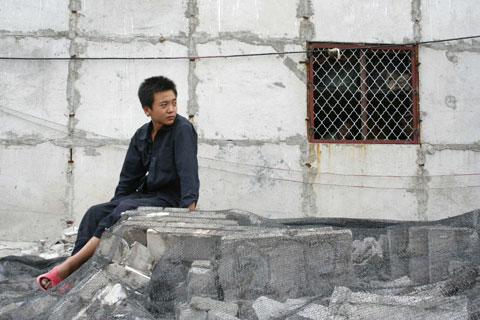
The massive number of migrant workers are in the danger of being culturally marginalized, a report published Monday by the country's top think tank warned.
Their enrichment needs have failed to draw the attention of the government, social organizations or employers, the Chinese Academy of Social Sciences (CASS) noted.
 |
In cultural terms, migrant workers live on a "lonely island" surrounded by an ocean of material prosperity in cities, according to the China Public Cultural Service Development Report 2007, which was compiled by the academy's cultural research center and the Shenzhen city cultural bureau.
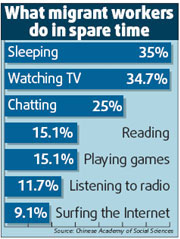
During their spare time, 35 percent sleep, 34.7 percent watch television and 25 percent shoot the breeze with their co-workers, according to a survey covering more than 8,000 migrant workers in 14 cities conducted by sociologists at Huazhong Normal University in Wuhan in 2005. The survey is part of the report.
They live in a small, separate world, according to the report. "Urban residents and migrant workers live segregated lives in general, and the former are not much interested in the latter," it quoted sociologists at Zhejiang University in Hangzhou as saying.
Fewer than a third of urban residents communicate with migrant workers regularly, and more than half do not like topics about migrant workers in their daily conversation, according to the sociologists.
Although less educated, migrant workers are keen on a cultural life, according to the survey. The four things that they want most to get information and for self-improvement are: Television, technical training, books and magazines, and the Internet.
But the survey said urban communities have not provided migrant workers any such facilities. Newspaper bulletins are the most commonly available, but only 22.7 percent of them have access to them.
"The government is giving more and more money to the cultural sector, but the question is whether this money is spent in a way that reflects social equity and justice," said Zhang Jiangang, a researcher at Huazhong Normal University who is editor-in-chief of the report.
Cities get the majority of the money. In Zhejiang Province alone, 11 cities have built "grand theaters", while 5,000 county-level cultural centers nationwide were closed between 2001 and 2006, which accounted for 12 percent of the all grassroots cultural centers.
|
|
|
||
|
||
|
|
|
|