 |
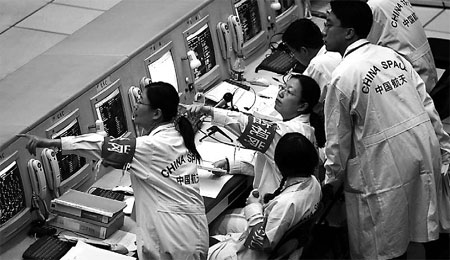
| Staff at the BACC keep a close eye on Chang'e I's progress yesterday as it enters the working orbit of the moon.Xu Jingxing |
The scientists and engineers behind the Chang'e I lunar probe, plotting its path through the infinite expanse of space, are not who you might expect.
The popular image of such brainiacs is one of aging men, bent over work that is far beyond the grasp of mere mortals.
But there are few white hairs and grizzled beards here.
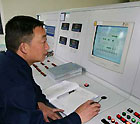
At the Beijing Aerospace Control Center (BACC), where thousands of instructions are sent to Chang'e I during its 380,000 km journey to tweak its course, a new generation is leading the way.
"Most of the people working in the 274 key positions graduated after 1994, and the average age of the main project managers is 30," Zhang Shengyuan, a senior official at the center, said.
Figures from the China Aerospace Science and Technology Corporation (CASTC) show about two-thirds of the 10,000-strong aerospace talent pool is made up of young people.
Between 1992 and 2003, the average age of rocket designers fell by 18 years.
Qie Weijun, 26, who earned his master's degree from Tsinghua University in 2005, is part of this new breed of young space scientists.
He manages the telemetry group at the BACC, controlling how messages are passed between the Earth and Chang'e I. The group completed 800 programs, every one error-free.
"I'm so proud to be a part of this group, although I am a little bit tired," Qie said.
But Qie is being modest. It reportedly took less than three years to prepare the Chang'e I mission. This is a very short time compared with the nine years it took Japan.
So why are there so many young people at the forefront of China's space program?
From 1968 to 1982, there was a lack of graduates at CASTC due to the "cultural revolution" (1966-76), Pan Houren, 70, the deputy commander of the Shenzhou III spacecraft, said.
"So to make up for this, they now train the young people more quickly," he said.
"The new generation of scientists specialize in innovation," Zhang said.
For instance, he said, the thermal control design for Chang'e I had been a tough challenge.
The side facing the sun has a high temperature, while the other side has a low temperature. As a result, it is hard maintaining a thermal balance inside the satellite.
But Sun Zezhou, 37, deputy chief designer of the satellite, came up with a solution.
He used a thermal conductive pipe to connect the two sides of the satellite. This would transfer heat from one side to the other, Zhang said.
But a lack of practical experience became an issue for the young scientists, Qie said. So young workers usually bring notebooks and take down the advice of older colleagues.
In the office of the BAAC, with the moon shining overhead, Zhang likes to look out from behind the windows and watch the bustling figures of the new generation.
"Looking at them is like looking at the future of China's aerospace industry.
(China Daily 11/08/2007 page5)