Designer with his head in the stars
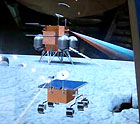
Named after the mythical fairy who flew to the moon, lunar orbiter Chang'e I is the realization of the dreams of the Chinese people to explore Earth's sole satellite.
And Ye Peijian, 62, the project's chief designer and commander-in-chief, is the man who helped the dream come true.
An academic with the Chinese Academy of Sciences, Ye joined the lunar program in 2004, just the year the plan to launch Chang'e I was approved by the State.
Soon he was in charge of a team, with an average age of less than 30, tackling a host of technical challenges to bring the project to fruition.
And yesterday, their efforts were rewarded as Chang'e I set off on its maiden voyage to the moon.
Ye was born in January 1945 in Taixing, a small county in Jiangsu Province.
After finishing high school, Ye applied to the aerospace departments of several universities but failed to secure a place. He was eventually accepted by the radio engineering department of Zhejiang University.
After graduating in 1968, his earlier disappointment soon faded when he was assigned to work at a factory affiliated to the former Aerospace Ministry, now the China Aerospace Science and Technology Corporation (CASTC) and China Aerospace Science and Industry Corporation (CASIC).
He was finally working in the field he was passionate about.
In 1980, Ye went to Switzerland to do his PhD. According to a local newspaper report, Ye never went to bars or theaters, choosing instead to spend all his time "working and learning".
In 1985, with a burning ambition to help his country, Ye returned to China.
In 1992, Ye was appointed deputy chief engineer on the research and development of the Resource-II satellite program. Four years later, he was promoted to chief designer and commander.
On September 1, 2000, the Resource II-01 satellite was successfully launched. Over the next four years, the program succeeded in launching Resource II-02 and Resource II-03.
The man who gave it his all
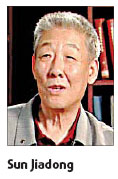
He had loads of unique experience gathered over decades of dedicated and laborious research. Otherwise, at 78, Sun Jiadong would have been overwhelmed by the constant pressures that come with his post as the chief architect of China's first lunar exploration program (CLEP).
The last active member of China's first generation of space experts, Sun was only 37 when he was named system designer of the country's first man-made satellite, Dongfanghong-1 (DFH-1).
Years before, he had aspired to become a civil engineer specializing in bridges. Instead, he was sent to the erstwhile Soviet Union's Rukfski Air Force Engineering College in Moscow to study aircraft design from 1951 to 1958.
On his return, Sun was made a rocket designer for the newly established institute for rockets and missiles under top Chinese rocket scientist Qian Xuesen.
He worked there until 1967, when the central government decided to set up the Chinese Academy of Space Technology (CAST). As CAST head, Qian handpicked Sun to lead DFH-1's system design team.
Qian's choice proved judicious in subsequent years. After the launch of DFH-1 in 1970, Sun served as the overall designer for China's second man-made satellite, first recoverable satellite, first remote sensing satellite, first stationary orbit test satellite, as well as the first intermediate range missile.
As such, he played a leading role in dealing with vital policymaking, engineering and coordination issues in each of these projects. By the time he was appointed chief designer of the Dongfanghong-3 (DFH-3) in the late 1980s, Sun seemed the obvious choice.
Aside from technical expertise, Sun, a former vice-minister of aerospace, was also head of Chinese delegations in a number of important satellite agreement negotiations with the US in the late 1980s and 1990s.

'I can have a good sleep tonight'
One of China's top rocket scientists will wake up today refreshed after enjoying his first decent night's sleep in a long time.
"I can finally have a good sleep tonight," chief commander Cen Zheng of the carrier-rocket system of the nation's first moon orbiter told China Central Television last night.
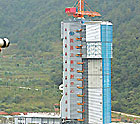
The circumlunar satellite named Chang'e I was carried up by the Long March 3A carrier rocket in the latter's 15th consecutive successful launch.
To prepare for it, Cen and his team carried out painstaking quality control procedures, he said.
"All the efforts have contributed to zero defects and a perfect blast-off.
"We have prepared for the worst, but achieved the best."
Born in December 1964 in a rural village of Central China's Hubei Province, Cen was introduced to rocket science at Beijing Aeronautics and Astronautics University in 1982.
An excellent academic performance earned him recommendation upon graduation to the China Research Institute of Carrier Rocket Technology under the China Aerospace Science and Technology Corporation.
There he became the chief commander of the Long March 3A series carrier rocket in 2004.
On February 8, 1994, carrying the hopes and dreams of Cen and his team aboard, the Long March 3 A finally made a successful debut flight, elevating China's rocket technology to a new height.
The young commander is modest about his success.
"I am not an expert, for there are so many areas that I don't know and need further study in," he said.
China Daily
(China Daily 10/25/2007 page7)