Doctor Ge Rili and his students were hiking up the 6,178 m Yuzhu Peak, Northwest China's Qinghai Province, on a scientific mission to find out more about altitude sickness.
The temperature had dropped to nearly -30 C and the team had reached the 5,800 m mark, at which its members were supposed to give blood samples. But they were reluctant. Without hesitation, the 55-year-old volunteered to go first and peeled off some of his clothes to give his blood.
"I wanted to develop my students' scientific attitudes through my action," recalled the Qinghai delegate to the 17th National Congress of the Communist Party of China (CPC), which closed yesterday.
The vice-president of Qinghai University embarked on a medical career in 1968, when he received one-month basic medical education and worked as a paramedic worker taking care of herdsmen in Qinghai.
He often felt frustrated as his patients suffered from heart or lung diseases, but there was nothing he could do to help because of his limited knowledge.
In 1972, Ge was sent to study at Shanghai Medical University. The Qinghai native had to overcome the language barrier and other difficulties in the course of his studies.
Ge said his classmates and tutors helped him through these difficult early days. Later, he would become one of the best students in his class.
This experience built up his confidence to pursue further studies, no matter where or what the language. In 1993, he studied in Japan and received a degree in medical science six years later. Then he went to the United States and earned a post-doctorate degree, in 2001.
Ge said hypoxia, or a shortage of oxygen in the body, is the key point in regard altitude sickness. He said US scientists had completed solid research in this area, for military purposes, as well as training for climbers.
"I decided it was a waste to stay in the US and research altitude sickness when I could conduct studies in my hometown, Qinghai," he said.
Ge returned to China in 2001 even though his US supervisor had applied for a green card for him. He then set up the Research Center of High Altitude Medicine, in Qinghai.
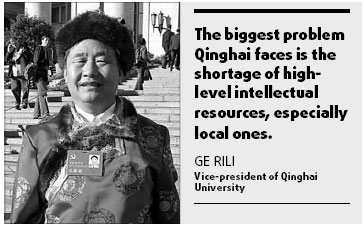
"The biggest problem Qinghai faces is the shortage of high-level intellectual resources, especially local ones," Ge said.
As a result Ge has trained 12 master's degree students and is tutoring three doctoral candidates this year.
Still, Ge finds time to provide medical services for one month every year for herdsmen in rural areas.
Ge said the incidence of heart disease in mountainous areas was on the rise, as the western regions in China have developed.
He said the incidence of heart disease here, in areas under 2,300 m, was negligible but over 4,500 m it was 10 percent.
(China Daily 10/22/2007 page7)