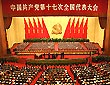
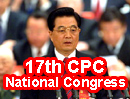
With 2,213 delegates assembling for the all-important 17th National Congress of the Communist Party of China (CPC) in Beijing today, the spotlight is fixed firmly on the Party's priorities for the next five years.
Discussion on new policy direction was extensive in the lead up to the 17th Congress as a slate of social problems marked by corruption and an ever-widening income gap after three decades of blistering development aroused widespread public concern.
Held amid different expectations, the congress's foremost role is to unify diverse outlooks held within the Party, reach consensus on further reforms and bed down goals for the next stage, said Wang Yukai, an expert with prominent think tank the National School of Administration.
The current leadership has focused heavily on the idea of "scientific concept of development" and "building a harmonious society".
In a June speech delivered by President Hu Jintao, which set the tone for the new congress, the two were placed on the same pedestal as previous Party charter principles including reform and opening up, emancipation of thought and building a well-off society in an all-around way.
According to Wang, the new emphasis on development based on science will rectify the long-standing policy of development at the cost of natural resources and social justice.
The country's sizzling growth has incurred huge energy consumption and high concentrations of resources in key development regions, resulting in a widening regional gap. The environmental cost has been estimated to hit about four percent of annual GDP.
More coordinated development between east and west and urban and rural, with sustainable development driven by innovation, is key to sustaining the new direction, said Wang.
Professor Zhou Tianyong from the Party School of the CPC Central Committee holds that the concept of "building a harmonious society" actually marks a watershed in the leadership. It now has to balance different interest groups amid changing social strata after nearly three decades of market-economy operations.
It was also brought out as a response to the existence of "acutely inharmonious factors" and social woes in recent years, marked by a widening wealth gap, corruption, pollution and inadequate government spending on education and health care.
Experts also noted that the country's economic reform had reached a bottleneck after loosening price control and restructuring SOEs. Reforms at the sophisticated level, including in the financial sector and the breaking up of monopoly sectors, remain thorny.
The outspoken Zhou stressed that reforming the government itself should first be deepened to ease social ills and further embed economic reform.
"That means the government will strengthen its public service, channel more funds into public service rather than investment," said Zhou.
That would also mean more checked and law-bounded government behaviors to curb corruption, less interference in the market, a clear-cut accountability system among the central and local authorities, and among different government organs, said Zhou.
Experts also note that economic and political reforms have been intertwined, further reforms in the political and government sectors, should be the most powerful and key part of the whole reform process.
Wang says that many issues have accumulated and can only be dealt with further political reforms.
These include efforts to promote CPC's internal transparency and consultation in policy making, strengthen internal supervision and introduce more competition within the Party.
Party School vice-president Li Junru said reform and improvements had been made in the intra-Party electoral system, the Party's policy-making mechanism and its internal supervisory system.
More democratic methods have been introduced in reshuffling Party leaders in the past year, including large-scale consultations and assessments among members on candidates for top positions. Also, local authorities have experimented with indigenous forms of checks and balances in recent years to find viable ways to curb corruption.
Professor Zhou also called for opening other democratic channels such as improving the people's political consultative conference, strengthening the supervisory role of the National People's Congress, enabling the judiciary to become more independent and promoting the role of non-government organizations.
Experts said they believed the congress would map out an integrated policy system that would mitigate growing pains the world's fourth biggest economy is currently feeling, and meet the Party's pledges on balanced development, social harmony and anti-corruption work.