Food revolution in Chinese army
Updated: 2007-10-05 11:54
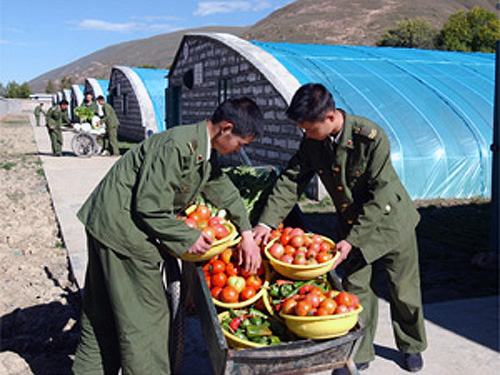 Soldiers pack vegetables they grow by themselves onto baskets in this undated file photo. [Xinhua] |
The latest increase was backdated to January 1 when each soldier's daily food subsidy was increased by 10 percent to 11 yuan (US$1.45). PLA pilots enjoy a daily per capita subsidy of 39 yuan (US$5.1) as they need more subsidies "to keep up their physical strength", says Feng. "They always get more care."
"The rise will help offset the impact of price hikes and improve food for soldiers, as military training demands a lot of energy," says Liao Xilong, director of the General Logistics Department of the PLA.
The government and Central Military Commission want the armed forces to share the country's booming economy and improved living standards, Liao says.
Each week, soldiers are required to have three or four kinds of fish and five or six types of animal protein.
"In the past, we prepared meals with whatever food we could get, without thinking about the nutritional value," says Li, from central China's Henan Province. He has received an "intermediate" catering certificate from the Ministry of Labor and Social Security.
Chef Zhang Yong, in charge of staple foods, says they conducted a survey of the regiment on preferences.
"More soldiers choose rice because there are more southerners, though we are all in Beijing, in northern China," says Zhang from the northern province of Shanxi. Usually people from southern China prefer rice and northern Chinese prefer flour-based staples such as steamed buns, noodles and rolls.
According to a PLA food supply standard, which defines the amount of protein, minerals and vitamins in line with international practice, the daily amount of meat or fish should be 280 grams per person and the percentage of animal protein should be 17 to 26 percent.
Jia, the regiment military supply director, says the daily per capita consumption of staples has dropped from 750 grams to 600 grams since January.
"The drop in staple food consumption indicates an increase in provision of nutritious non-staple foods," says Jia, adding that personnel no longer depend on staples to allay their hunger.
"When I joined the army at 18, I could eat about a dozen steamed buns because there was no other food," says a senior colonel who has been in service for more than two decades.
The PLA has trained its first ever group of 101 military dietitians this year to help scientifically adjust menus in accordance with training intensity, says Jia, adding that previously dietitians only appeared in air force canteens and military hospitals.
Soldiers get extra festival subsidies of 10 yuan (US$1.3) per day per person on occasions such as the first day of the May Day, National Day, New Year's Day and Army Day and the first three days of the traditional Spring Festival.
Jia said they could have more for meals and snacks, as well as drinks on festivals. "But alcohol is not allowed," he said, adding that the liquor ban started at the beginning of 1990s.
The rise of the PLA budget this year also helped fund a large-scale renovation of military canteens.
Most military canteens were transformed into McDonalds-like dining rooms, containing standard cupboards, plate racks, dishware, tables and chairs, says Jia.
Sixteen types of processing machines were installed for meat, bean curd, vegetables, dumplings and steamed buns, and large computer screens show the cost and calorie-count of each meal.


|
|
|
||
|
||
|
|
|
|