The work an envoy did to improve ties with Japan
Updated: 2007-09-28 07:21
During his three years in Tokyo, Wang delivered more than 100 lectures at universities and other institutions, too, sharing in earnest the vision of China on issues related to bilateral relations and the world. Armed with economic and military statistics from across world, Wang spoke about China's peaceful rise and the reasons behind the increase in the country's military budget while delivering a speech to military cadets at the National Defense Academy of Japan on November 2, 2005.
 |
|
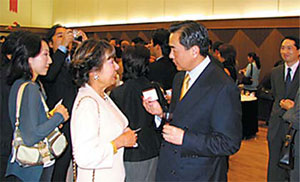
Left: Wang Yi talks with Japanese visitors invited to the Chinese Embassy in Tokyo in November 2004. Most of the Japanese were living or working near the embassy. [Courtesy of the Chinese Embassy to Japan] |
He quoted David Hale as saying that the openness with which China was rising not only enabled it to succeed, but also restricted its direction and constrained its behavior. Wang quoted Hale as saying that China can hardly afford military expansion.
On April 15, 2006, he started a 10-lecture series on China at Waseda University, during which Chinese diplomats took turns to talk about China's development in areas such the economy, culture, diplomacy, education, science and technology and foreign trade. Among the events that Wang attended were the openings of new Confucius institutes, arts exhibitions, film premieres and other cultural events because he believes cultural exchanges are the best medium to increase mutual understanding.
"I believe ambassador Wang and his team played their role in thawing the ice in China-Japan relations," Liu Jiangyong says. Today, China and Japan talk about taking forward their relations to a new phase, forging strategic and mutually beneficial ties, but Wang said before leaving Japan that bilateral relations still faced challenges despite the opportunities that lay ahead.
"We need to continue our efforts to enhance mutual political trust, expand common interest, improve people's understanding towards each other to ensure long-term, stable and healthy development of our relations," he said.
Besides promoting bilateral ties and understanding, Wang said the embassy should also serve the about 600,000 Chinese living in Japan. He used to invite such Chinese people to the embassy to celebrate traditional festivals. He organized open house sessions for them, too, so that they could learn more about the embassy's work. During the first open session on June 26, this year, Wang, held a mike, led a tour of his residence, explained in detail the origins of the calligraphy works, porcelain and other art pieces displayed there.
"I felt as if I was at home," says Lin Sifu, vice-president of the Federation of Tokyo Overseas Chinese Associations.
Earlier this month, Wang read out a letter from the mother of a student studying in Japan in his farewell speech to the Chinese living in Japan. The mother had thanked the consulate staff for helping her son, detained by the Japanese police in a case he was not involved in. The consulate staff looked into the matter and eventually helped clear his name and enabled him to return to his studies.
"I must tell you that diplomats are public servants and it is our duty to serve them," Wang told the gathering of Chinese in the embassy. And that's something he really believes in.


|
|
|
||
|
||
|
|
|
|