A friend who has been around Beijing's hospitality scene for some 10 years told me last week that the tradition of exchanging mooncakes to mark the Mid-Autumn Festival was in decline. This, she said, was due to the changing tastes and lifestyles of the modern Chinese, who would rather nip into the nearest Starbucks for a sweet pick-me-up than indulge in something as heavy as a mooncake, which is surprisingly weighty for its size and leaves a ring of grease on whatever surface it touches.

But even if less people are buying, the makers are still trying. Even Starbucks has gotten in on the festival spirit, offering a couple of varieties of the cakes. Colored green or brown, these look more like fussy cakes of soap.
In the bakeries and restaurants around the city, those fancy red and gold gift boxes on show hold a mind-boggling array of flavors. Some fillings are traditional, others bizarre. For the uninitiated, biting into these round cakes is a lucky - or unlucky - dip.
Chain cake shops have boosted their mooncake ranges by adding popular Western-influenced flavors to the more traditional fillings on offer. This approach doesn't always guarantee a palate-pleasing experience, especially when the filling is chocolate or bubblegum, but the pastry better suited to a meat pie.
|
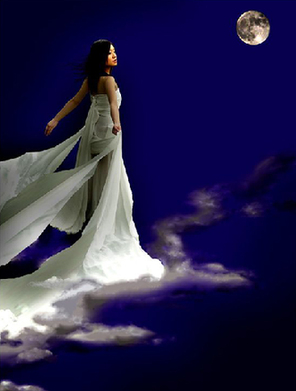
An imaginary picture of Chang'e flying to the moon
|
Some of the ritzier hotels around town have taken a different approach to the mooncake festival this year, with the same savory pastry encasing ingredients that could be straight off the menu for a 5-star banquet. Posh nosh being pureed and stuffed into little cakes includes satay beef, abalone, bird's nest and shark's fin.
But, creative interpretations of the cakes aside, the Moon Festival would have to be about the most romantic of national holidays. An evening devoted to staring up at the sky, soaking in the silver light from the full moon while nibbling (sometimes) sweet cake and sipping red wine. This must be what the poets and ballad writers had in mind when they penned their ubiquitous odes to the moon.
Falling on the 15th day of the 8th lunar month, it was the time of year when the emperors of ancient China would offer sacrifice to the moon, which was at its fullest and brightest. Over time, celebration spread to the common people, growing to be a major festival.
There are many lyrical legends surrounding the origins of the festival. One of the prettiest is the tale of Chang E, the mythical Chinese beauty who remains in her moon palace today, immortal but miserable in isolation.
The story is set in antiquity, in an age when ten suns reigned in the sky, plunging the earth into crisis. Until then, the suns had risen one by one, but now they took to the sky at once, scorching everything below. With crops dying and people driven to poverty, a fearless archer named Hou Yi was charged with shooting down the merciless suns. Standing on top of the Kunlun Mountain, he drew back his bow and shot them down, one by one, until just one sun remained to warm the earth.
Hou Yi was rewarded for his services to the earth by the Empress of Heaven, who presented him with the elixir of life. Hou Yi gave the elixir to his lovely wife Chang E to keep safe. She placed it in a treasure box, but was seen by a man named Peng Meng, who rushed into her chamber with a sword and demanded the elixir.
Instead of giving him his reward, she took the elixir herself and floated up to heaven. The pining Hou Yi was left behind, casting his eyes to the moon in the hope of catching a glimpse of his lost love.
Contact the author at viva_goldner@yahoo.com.au
(China Daily 09/12/2007 page15)