China establishes corruption prevention bureau
Updated: 2007-09-13 11:25
|
|
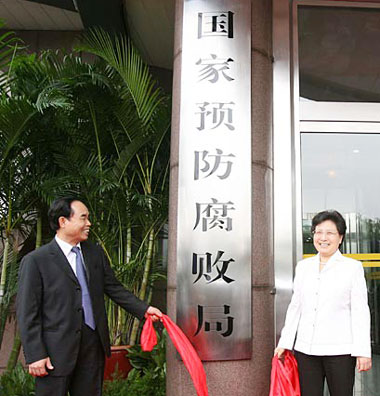
China announced in Beijing Thursday the establishment of the National Bureau of Corruption Prevention (NBCP).
"The founding of the bureau is to meet the need to effectively prevent corruption in China," said bureau head Ma Wen at a press conference Thursday.
Ma, who is also Minister of Supervision, said the bureau will focus on supervising and regulating the use of power and adopt effective measures to prevent the abuse of power.
She said the bureau will study ways to stem corruption at their roots, constantly improve corruption prevention systems, push for the sound operation of these systems and coordinate corruption prevention efforts of various departments.
The new bureau will report directly to the State Council, or China's cabinet.
"The bureau won't step in the investigation of individual cases as it doesn't have the power," said Qu Wanxiang, deputy head of the bureau.
Qu said the bureau has been assigned the task to push forward transparency of government information at various levels, which he said is the way to "prevent corruption at its root".
The NBCP will also evaluate loopholes in new policies that may give rise to corruption and study countermeasures.
|
|
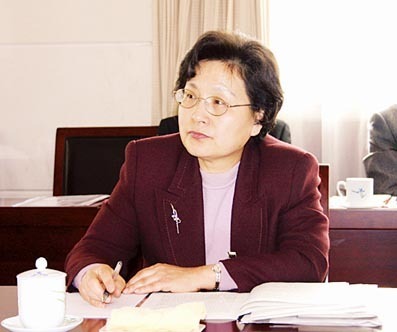
"The NBCP staff will collect and analyze information from sectors including banks, land use, medicine and telecommunications and share it with other departments," Qu said.
He said this is an important basic job for finding and exposing corruption as early as possible, a deterrent to corruption activities and an effective way to prevent corruption.
The bureau is also tasked to inspect corruption prevention work at various levels, conduct pilot projects and develop a set of standards to judge whether a department or an official is clean.
Qu said the bureau will guide the anti-corruption work in companies, public undertakings and non-governmental organizations, help trade associations to establish self-discipline systems and mechanisms, prevent commercial bribes, and extend corruption prevention work to rural organizations as well as urban communities.
"Corruption not only happens among civil servants in government departments, but also among employees in private sectors and other organizations," he said.
The bureau will also engage in international cooperation and international aid in corruption prevention, according to Qu.
The bureau will, under the framework of the United Nations Convention Against Corruption, offer help to developing countries on corruption prevention and work to win technical support and other sorts of help from foreign countries or international organizations, Qu said.
He said the bureau will learn from the anti-corruption experience of foreign countries and would like to exchange information with international organizations and other countries.
China punished 16 ministerial-level or higher officials for "serious corruption" in the last five years.
According to the Central Commission for Discipline Inspection (CCDI), 97,260 officials were disciplined last year, more than 80 percent of whom had failed to carry out duties, taken bribes or violated the party's financial rules.
Several high-profile officials had fallen in corruption scandals, including the former head of the food and drug administration and former party head of China's economic hub Shanghai.
"We can't count on punishment only. It will take effect for some time but did not touch the root of corruption. We need to enhance the preventive measures," said Yan Qunli, a CCDI official in charge of anti-corruption publicity and education programs.
China's policies to prevent corruption used to focus on moral education of government and party officials but in recent years a series of rules and regulations were issued to deal with systemic loopholes, covering administrative approvals, financial management, official promotion and penalty on corrupted officials.
The CCDI also kept working out policies against "new forms of corruption" trying to catch as many corrupted officials as possible.
Four months ago it has issued a regulation covering several new fields of bribery like taking stocks and shares as gifts, buying houses or cars at ridiculously low prices from those who ask them for favors, laundering bribes by gambling and asking bribers to arrange jobs after retirement.
|
|
|
||
|
||
|
|
|
|