New ecological attitudes revive Beijing's rivers
By Nie Ligao (chinadaily.com.cn)Updated: 2007-07-26 10:20
Beijing is planting trees and plants along riverbanks instead of covering
them with concrete to fix its river system. It has taken almost 10 years for the
capital to accept and use this idea.
The ecosystems in the streams are
gradually coming back to life because of the cleaner water, providing a good
habitat for animals and plants, and ideal leisure sites for local residents.
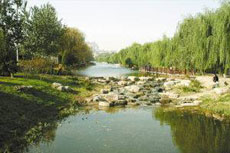 Zhuanhe which connects with Kun Ming Lake in the Summer Palace is one of successful example of the river ecological treatment in Beijing. [China Youth Daily] |
Originally, Beijing only wanted to control the floods by letting water flow out as soon as possible. Therefore, riverbanks were cemented down in order to prevent water leakage and the growth of plants, which could slow the water speed down.
However, the shortage of rainfall in Beijing since 1999 showed that this method was not correct. On the one hand, streams had less fresh water to clean themselves. On the other, more polluted water was dumped into the rivers as more people moved into the capital.
And in the summer of 2001, something bad happened.
"The rivers in Beijing turned blue overnight and gave off a smelly odor," said Liu Peibin, vice engineer of Beijing Water Authority. There was an algae bloom due to so much pollution in the water. Algae covered the water surface and consumed most of the oxygen, and many creatures in the water died as a result.
These "concrete pools" became the haven for swarms of mosquitoes which forced tens of thousands of residents nearby to close their windows and doors tightly especially in summer days.
The water authorities had to act quickly for public safety. The first step was to demolish the concrete covering the riverbanks. The soil was exposed to water again, and the water could circulate down to the riverbank. Secondly, in order to stimulate oxygen in the streams, engineers put big stones in the water to create mini waterfalls. And they grew trees like willows and plants such as bulrush along the riverbanks.
"Bulrush can purify polluted water through absorbing nitrogen and phosphorus
in the water and exhaling oxygen," Deng added. "Gradually Zhuanhe came back to
life and got rid of the polluted and smelly water. This would be impossible
today if the brook was still covered in concrete."
"What we did with
Zhuanhe is a milestone in the progress of river treatment with new ecological
ideas," said Deng Zhuozhi, vice engineer of Beijing Water Project Institute. He
took charge of the Zhuanhe project.
"How to fix up rivers depends on our attitude towards floods. We should learn to make friends with floods in a country where two-thirds of China's cities are short of water. Therefore we should reserve water as much as possible instead of discharging it ineffectively," said Yu.
|
||
|
||
|
|