| Home |
| News |
| Celebration |
| HK Today |
| HK in Retrospect |
| Video |
| Photo |
|
chinadaily.com.cn | ||||||||
|
|||||||||
|
HK 10 Years > News |
|
Stock market shows its resilience
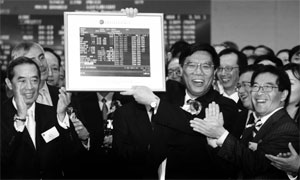
Hong Kong is now the world's second largest IPO market and its seventh largest exchange in terms of market capitalization. On Friday, its shares closed at 21,999.91, an all-time high. But such a strong position did not come easily; the market was in a terrible lull in the three years after the reunification. Hong Kong investors fanatically speculated in red-chip (State-owned firms on the mainland) shares a couple of months before the reunification. The initial public offering (IPO) for the first batch of red-chips companies, including Beijing Enterprises Holdings and Beijing North Start, was massively oversubscribed. "The speculative atmosphere spread over the market at that time," Ronald Wan, managing director and head of investment banking at BoCom International, said. "Many investors were tantalized by the idea of making easy money by bidding on undervalued stocks." The bubble finally burst, however. Red-chip shares plunged at the outbreak of the Asian financial crisis in September 1997. Share prices of major red-chips such as China Everbright tumbled more than 90 percent the following month. "It was a watershed. Investors began to move their money away from red-chips, which led to their share prices stagnating for years," Wan said. "We thought investors might lose confidence in conglomerates but I couldn't understand at that time because that type of companies (conglomerates) are supposed to be good for diversifying risks," Bai Jinrong, general manager of Beijing Enterprises Group Holdings, said. "But I later learned the lesson to quicken the reform of the company," he said. The problems extended to foreign exchange business, too. Hong Kong's long-adopted fixed exchange system was under attack from George Soros-led international funds during the Asian financial crisis since 1997. To counter the speculation, the Hong Kong Monetary Authority (HKMA) used foreign reserves to absorb excess Hong Kong dollars in the market in August 1998. The banking regulator bought blue-chip shares to lift the Hang Seng Index and stabilize the equity market. In September 1998, the HKMA launched seven reforms to stabilize the financial regime, making sure the Hong Kong dollar was pegged to the greenback. Donald Tsang, then financial secretary, said: "The reforms revamped our ability to defend speculators from manipulating the exchange market and boost the public's confidence in our financial system." Joseph Yam, chief executive of the HKMA, said: "The Hong Kong dollar would have depreciated 40 percent if the fixed-exchange system was discarded, and that might have lead to inflation rising from 4.5 percent to double digits. We had no choice but to defend the link exchange system." After overcoming the Asian financial crisis, the Hong Kong equity market had good times ahead. A large number of mainland companies' IPOs helped send the shares to record highs. The influence of mainland companies on the Hong Kong equity market sharply increased in terms of fund raising and market capitalization after 2003. In October 2006, the Industrial and Commercial Bank of China (ICBC) simultaneously went public on both the Hong Kong and Shanghai bourses and, becoming the first A+H-share dual-listed share. The IPO also broke a record in fund-raising, collecting HK$140 billion. "Mainland companies accounted for 20 percent of the overall market capitalization of Hong Kong securities market in 1997, compared with 50 percent today. The change is very significant," Ronald Arculli, chairman of Hong Kong Exchanges and Clearing, said. Given the growing influence of mainland firms, HSI Services Ltd, the compiler of the benchmark Hang Seng Index, decided to include H-share companies in the index in February 2006. H-share firms are mainland-registered but Hong Kong-listed companies. China Construction Bank was the first State-owned firm to join the index. Other giant mainland companies, such as China Life, Bank of China, ICBC, Sinopec Corp and Ping An Insurance, were also later included. Vincent Kwan, director and general manager of HSI Services Ltd said the number of companies would be extended to 50 in the long run. "The addition of H-share companies enables the index to reflect the market better," he said.
(China Daily 06/23/2007 page3) |
|
||||||
Copyright 1995-2007. All rights reserved. |
马关县| 韩城市| 诸暨市| 竹山县| 台山市| 平顶山市| 昌乐县| 佳木斯市| 梅河口市| 民和| 老河口市| 枞阳县| 托克托县| 绥德县| 胶州市| 普洱| 江口县| 太和县| 广平县| 廉江市| 满城县| 随州市| 塘沽区| 永川市| 金湖县| 弥勒县| 二连浩特市| 湘潭市| 阿拉善右旗| 乌兰县| 漳州市| 观塘区| 盱眙县| 丁青县| 行唐县| 许昌市| 陕西省| 长岭县| 蒙山县| 宁强县| 积石山|