Updated standards in the pipeline
By Hu Yinan (China Daily)Updated: 2007-06-02 09:09
A much-needed update to the existing standards for drinking water, as well as 13 relevant inspection methods, will be officially implemented on July 1, sources with Ministry of Health and National Bureau of Standards said.
The number of monitoring indicators will increase from 35 to 106 under the new standards, which were designed to comprehensively improve drinking water safety.
Earlier this week, Taihu Lake near Wuxi, a city in East China's Jiangsu Province, suffered a massive outbreak of algae, which left millions of people with a severely contaminated water supply.
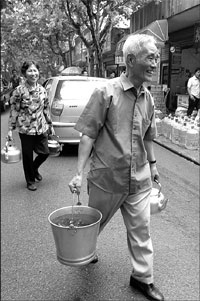 An old man in Wuxi, East China's Jiangsu Province, carries away the water he bought after lining up for seven hours. He had earlier lined up for 12 hours just to buy clean water. [China Daily]  |
In 2005, a toxic spill in the Songhua River seriously affected drinking water for four days in Harbin, an urban center at China's northern frontier.
An old man in Wuxi, East China's Jiangsu Province, carries away the water he
bought after lining up for seven hours. He had earlier lined up for 12 hours
just to buy clean water. GAO ERQIANG
Water pollution is also a major concern in other parts of the country.
Existing drinking water standards were issued in 1985, years before large-scale industrialization projects flourished in the country, boosting local economies while simultaneously polluting drinking water sources.
The contamination emerged as a national public health issue in the 1990s, as did nationwide discussions on how to amend the existing standards.
The revised regulations were initially scheduled to come into force on June 1, 2005, but they were not even released until a year and a half later, in December 2006.
Wang Zhansheng, a retired professor at the Chinese Academy of Water Supply and Drainage, said the country's drinking water standards lag behind international norms by at least 20 years.
The current standards include only two indicators of organic substances - none for algae toxins - and exclude a number of key contaminants, such as nitrites and bromates, Wang said.
Consequently, the vast majority of poisonous substances in drinking water are somehow legally considered safe, he said.
Public health authorities' work in establishing drinking water norms and standards is not a static one, "because as changes occur in drinking-water supply practice, in technologies and in materials available ... so health priorities and responses to them will also change," the third and current edition of the World Health Organization (WHO)'s guidelines for drinking water quality states.
An unnamed senior researcher with the department of water environment at the China institute of water resources and hydropower research considers the new standards a sign of progress, but thinks much more remains to be done.
"The government has invested lots of money in improving drinking water quality, but the results have been less than rewarding," she told China Daily.
For example, more than 6 billion yuan ($785 million) has been earmarked for the cleaning up of Dianchi Lake in Kunming, capital of Yunnan, where the once cleanest of all waters has fallen victim to a year after year of industrial waste.
But the investments underachieved, she said.
While claiming that human activity is the root cause of water degradation, the researcher said an update to the standards must accompany detailed inspection measures as well as procedures to ensure conservation and protection of water sources, without which authorities will only scratch the surface.
Ultimately, the amended drinking water standards should be a new beginning rather than the endpoint.
In the future, "legislation should go hand-in-hand with law enforcement," she said.
|
||
|
||
|
|