Anxiety, emptiness fuel Confucius craze in China
(Reuters)Updated: 2007-05-09 08:54
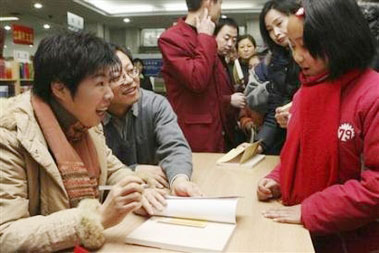 Yu Dan (L), a professor from Beijing Normal University, signs an autograph for readers at a book store in Xi'an, northwest China's Shaanxi province, in this January 24, 2007 file photo. [newsphoto]  |
"Notes on reading the Analects", by Beijing Normal University professor Yu Dan, has become China's best-selling book in recent memory, defying critics who say it turns Confucian thought into self-help pulp for the modern age.
"It is good to have these teachings from old times because people are too selfish now," 60-year-old accountant Qu Juan said of the book that has sold over 3 million copies in four months. "Everybody cares only about making money after the economic reforms," she said, flipping through the softback at a book shop.
Yu first shot to fame in October when she went on state TV to lecture on the Analects, a canon of Confucianism recording discussions between the ancient Chinese sage Confucius (551-479 BC) and his disciples. She wrote the book based on the TV transcripts.
Her mass following tells of deep anxiety about morality and beliefs in a society that has gone through a disorienting transformation in recent decades, analysts said.
"We were taught Marxism and Leninism in schools," said Tian Na, a 25-year-old teacher who bought the book on the Internet.
"But when I became independent and went to college, I saw professors take bribes and I felt the old slogans like 'serve the people' were no longer relevant," she said.
Yu's book appeals across generations, despite the vastly different experiences of growing up as Tian did, in the relatively prosperous and stable reform era of the 1980s and 90s, or as the older generation did, during the time of Mao Zedong.
INEXTRICABLE ANXIETY
Confucian philosophy, emphasising high personal morality and a strict hierarchy of social relationships, was endorsed by China's imperial rulers over the past two millennia and still has huge influence in other East Asian nations.
Today, market-oriented reforms in China since the late 1970s have brought dazzling growth and greatly improved living conditions, but also a yawning wealth gap and social tensions.
The shattering of Communist ideals and the rush to get rich -- considered almost the sole indicator of success -- with whatever means have left many feeling lost or resentful.
"A nation which used to value morality above everything else suddenly finds itself in a situation without a moral benchmark. That causes inextricable anxiety," said Zhu Dake, a professor and cultural critic at Tongji University in Shanghai.
Yu delivers her message with a simplicity that has charmed readers but galls critics trained in the classics.
"The essence of the Analects is to tell us how to live a happy life that our souls crave for," Yu wrote in the book. "Don't assume we should look up to it ... it is simply about orienting yourself in modern life."
LARGEST SOUL MARKET
Detractors argue that Yu offers little more than a mix of distorted ancient teachings and motivational stories tailored to tell readers how to handle stress and relationships.
They say Yu takes advantage of the public's ignorance of classic literature and her success is a symptom of, rather than a prescription to the ailments of crazy commercialism and declining ethics characteristic of China nowadays.
"Her moral preaching might be helpful in re-building more healthy social relationships now centred on money, but she has neither the courage nor the impulse to explore the ultimate meaning of life," said Zhu.
Yet such academic criticism has failed to dampen Yu's supporters. They snapped up 15,000 autographed copies of her latest book in a single day. The book offers similar content but borrows the thought of Zhuangzi, an ancient Taoist philosopher . Writer Zha Jianying said Yu's books had found a frantic audience in the ideological vacuum following the absence of a "state religion" which has made China the world's "largest soul market" with its 1.3 billion population.
"So be it Buddhism, Christianity or Yu Dan's version of Confucius, people embrace them," said Zha, author of an acclaimed 2006 book of interviews with a dozen Chinese cultural figures.
"There are so many wounded, helpless souls that are desperate to find something to believe in and to hold on to after these drastic changes."
|
||
|
||
|
|