Japan can help China improve environment
By Goshi Sato (China Daily)Updated: 2007-04-10 07:10
Visitors to China who take in the mushrooming skyscrapers, luxury cars and fashionably attired citizens can easily forget that they are in a developing nation. Because of China's economic growth some Japanese are suggesting Japan should cut its official development assistance.
However, even a cursory review of China's environmental problems makes it clear that the step would have bad and far-reaching consequences for Japan.
Take, for example, the fact that this past winter, 1,400 coal boilers were used to supply hot water to homes for central heating in Beijing. Many of them are not fitted with desulfurization systems so are discharging considerable amounts of sulfur dioxide and nitrogen oxides into the atmosphere. This contributes to high levels of air pollution.
In Beijing, the air quality is not satisfactory on more
than 100 days a year. In fact, on the day in February I visited Beijing to look
into the environmental situation, the air was so thick with photochemical smog
that I found myself coughing as I walked the streets. 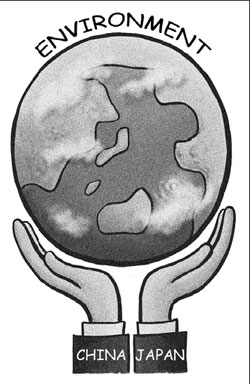
A cogeneration plant that uses gas boilers is now under construction in Zhongguancun, an electronic zone. When completed, it will replace more than 100 small coal boilers. This is expected to cut annual coal consumption by 300,000 tons, emissions of sulfur dioxide by 1,755 tons, nitrogen oxides by 1,229 tons and soot dust by 2,103 tons.
The main part of the construction cost of the plant is covered by yen loans. The yen loan is an ultra-long-term, ultra-low-interest means of assistance that the Japanese government provides to developing nations as part of the economic cooperation provided for in bilateral agreements.
For several years, Japan has been giving China yen loans to put toward important environmental initiatives. They are being used to install desulfurization and dust collection systems at ironworks, to build water supply systems and to construct sewerage networks.
Currently, 60 environmental conservation projects funded by yen loans are under way in China.
However, in 2004, before a summit meeting between then Prime Minister Junichiro Koizumi and Chinese Premier Wen Jiabao in Laos, Koizumi said it was time Japan withdrew the loans. Since then, the Japanese government has decided to stop extending them to China from 2008.
It is true that Beijing and other local governments in China must be responsible for dealing with their own domestic environmental problems. But developing countries will always be inclined to attach greater importance to economic development than environmental protection.
This is clear from the experience of Japan, which also generated enormous amounts of pollution during its period of high economic growth. To solve China's environmental problems, outside technology, experience and funds are needed.
Moreover, pollution transcends national borders. Polluted air and water reach Japanese shores across the sea. The solution to the Chinese environmental problem is important not only for Japan but also the global community. Japan should continue to provide yen loans tied to environmental projects or come up with other support measures to replace them.
The author is an assistant with Kyushu University's faculty of agriculture. He specializes in environmental economics. The Asahi Shimbun
(China Daily 04/10/2007 page11)
|
||
|
||
|
|