Study raises questions about hukou
By Xie Chuanjiao (China Daily)Updated: 2007-04-10 07:09
As Beijing's migrant population continues to grow, some experts believe the decades-old hukou system is outmoded and broken.
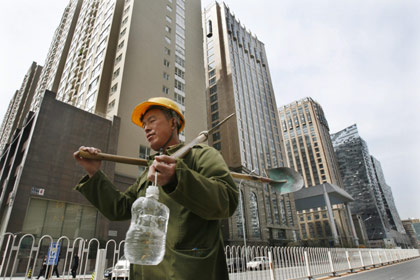 A migrant worker walks past a row of new property buildings in Beijing April 4, 2007. As Beijing's migrant population continues to grow, some experts believe the decades-old hukou system is outmoded and broken. [Reuters]  |
The policy requires migrants to get temporary permits, or the much harder to obtain hukou, once they move to the city.
These days, a growing number of those who relocate to find better jobs in Beijing tend to stay longer or even resettle with their entire families, according to a study by the Renmin University of China.
The investigation revealed that this "floating population" in Beijing, currently at 3.57 million, stays an average of 4.8 years in the city.
In addition, over 51 percent of those remain for more than five years while over 41 percent bring the whole family.
"It is getting trendier for them to come and reside with the whole family," said Zhai Zhenwu, dean of the School of Social and Population Science.
Representing 23 percent of local residents, most migrants live in the nearby suburban areas and villages within downtown.
The thriving low-skilled labor market in Beijing has been a major source of jobs for unskilled migrants.
Zhai said the most basic jobs in the city offer higher wages that far exceed what migrants would have earned in rural areas. But city life also means a poor quality of life and inadequate social services.
For example, statistics show that the urban per capita disposable income in Beijing is five times more than the average in rural areas of neighboring Hebei Province and 6.7 times more than that in Anhui Province.
China's hukou system, established in the 1950s, divided the Chinese into two categories: rural and non-rural households. The policy was established to control population migration, largely from rural to urban areas.
Under the policy, rural people are not granted social security in cities and are restricted from receiving public services such as education, medical care, housing and employment.
On the other hand, their urban compatriots have no access to farmland in the countryside.
For years, non-rural residency, especially in cities like Beijing and Shanghai, has been a difficult goal for outsiders, particularly rural migrant workers.
According to Zhang Chewei, vice-president of the Research Institute of Population Science at the Chinese Academy of Social Sciences in Beijing, the system needs work.
He referred to the "unfair treatment in social recourses and justice, also it hinders market development in both rural and urban areas."
For example, each migrant worker must fork over 20,000 to 30,000 yuan ($2,597 to $3,896) for a child to enrol in a local primary or middle school. And they're often turned down if they try to buy affordable homes in urban areas.
It is estimated that more than 120 million rural workers live in cities throughout China.
"Hukou has played a significant role as basic data provider and identification registration in certain historical periods, but it has become neither scientific nor rational," Zhang said.
Reform of the hukou system began in 1992, but the policy remains complicated and unfair for many.
Last month, the Ministry of Public Security said the country will reform the system, but did not offer any details.
Yu Lingyun, a professor with the Law School of Tsinghua University, called for the system to be abolished.
"It is not hukou that has robbed the social welfare of the 'floating population,' but the discriminating system itself, and most fundamentally the limited public finance," Yu told China Daily yesterday.
"If not for the hukou system, schools can find other reasons to decline a rural student," he said. "Under current conditions, at least we should not bear any prejudice against them," he said.
|
||
|
||
|
|