
Japan's wartime deeds not easily forgotten in China
Updated: 2007-04-08 10:19
The war may have ended more than 60 years ago, but in this Beijing suburb gaggles of schoolchildren and office workers daily relive battles the Chinese fought with Japanese invaders so long ago.
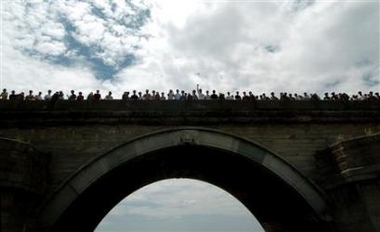 Chinese demonstrators gather at the Marco Polo Bridge to mark the 67th anniversary of the July 7 clash with Japanese troops in Beijing July 7, 2004. [Reuters] |
he Marco Polo Bridge, where a skirmish on July 7, 1937, provided the spark for all-out Sino-Japanese war, is one part of China where the history of Japan's brutal invasion seems destined never to be forgotten, despite slowly warming official ties.
"It gives me great pain to come here," said student Li Jie, 25, standing in front of pictures of disembowelled women at the nearby Museum of the War of Chinese People's Resistance Against Japanese Agression.
"It is very tolerant of Premier Wen to go to Japan, considering our history and how much we suffered," she added.
Premier Wen Jiabao flies to Tokyo on Wednesday, the first time a leader of China has visited its eastern neighbour and bitter wartime adversary in seven years.
The trip marks a turning point in relations, poisoned in recent years by spats over history that have at times boiled over into violence.
China thinks Japan has not properly atoned or apologised for its wartime past, especially the 1937 Nanjing Massacre, and this is a message drummed relentlessly into Chinese from an early age.
Still, there is cautious support from some for Wen's Japan visit.
"The Chinese people hope that Wen's trip to Japan can help melt the ice, and gradually open up some of the disagreements and contradictions," museum deputy curator Li Zongyuan told Reuters.
UNDER THE CARPET?
But that does not mean the past should be swept under the carpet in the interests of diplomacy, he added.
"We must not forget history," Li said. "These are questions that cannot be avoided."
The old imperial bridge itself is carefully preserved inside a park, yet modern Beijing is slowly creeping up on what was once a remote outpost of the capital. Apartment blocks rise nearby.
The museum is dedicated to ensuring remembrance of the Japanese invasion and occupation as China's leaders wish the events to be recorded.
"Remember history well, do not forget the past," enjoins calligraphy written by President Hu Jintao inside the low-rise building, which receives an estimated 300,000 visitors annually, including some 10,000 Japanese.
The exhibits show graphic pictures of decapitated Chinese, rusting swords and implements of torture. There is also at least one skull, purportedly of a Nanjing massacre victim.
"We are such close neighbours, we should be good friends," said civil servant Li Dongqing, 40, at the museum with a friend.
"Japan's refusal to face up to its past is a terrible strain. But I'm glad Premier Wen is going," she added, her back to a mural of heroic-looking Chinese soldiers entitled "Glorious Victory".
Xinhua news agency said last week no fewer than four Chinese films about the Nanjing massacre were planned for this year, the 70th anniversary of the capture of China's former capital.
China says Japanese Imperial troops slaughtered 300,000 men, women and children in Nanjing, then known as Nanking. An Allied tribunal after World War Two put the death toll at about 142,000.
|
||
|
||
|
|
|
|