Unifed tax rate to apply to domestic, foreign-funded enterprises
(AFP)Updated: 2007-03-02 09:10
BEIJING - When the National People's Congress kicks off its annual series of meetings on Monday, one law expected to be passed will unify corporate income tax rates at 25 percent, ending special privileges for foreigners.
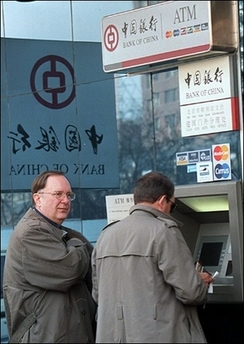 Two foreigners use a Bank of China automated teller machine (ATM) in Beijing in this file photo.[AFP] |
"A unified tax code will create a taxation environment that favours fair competition among all ventures registered in China."
Or that is the theory at least. Foreigners are cautiously waiting to see what the reality will be.
"The question is whether there will be all sorts of dispensations and cozy arrangements for Chinese enterprises," said a Western executive who asked not to be identified.
The new 25 percent tax rate means foreign enterprises which so far have been subject to a 15 percent income tax will have to pay a combined 5.1 billion dollars extra every year, according to official calculations.
Chinese companies, meanwhile, will pay 16.8 billion dollars less, since up until now they have been taxed at 33 percent.
No wonder, then, that Chinese executives such as Lu Honghua, general manager of Changchun Huaxin Food, a candy maker in northeast China, sees the measure as justice finally reigning supreme.
"For us domestic enterprises, the unification of the rates signals that all the enterprises have returned to the same starting point and that all market players are put on an equal footing," Lu told state media.
One oft-cited reason for the unified tax rate is China's entry five years ago into the World Trade Organisation, which says foreigners and locals must be treated equally.
Just as important, however, are changes in the requirements of the Chinese economy now compared with when the dual tax regime was devised.
"When the differential tax treatment was introduced, it reflected a need for a policy of reform and of opening," said Wang Li, a senior finance ministry official.
"We needed to attract the foreign capital, to accelerate the development of the economy."
But China is no longer in desperate need of funds. It has more than half a million foreign enterprises, received more than 60 billion dollars in investment last year, and can start paying attention to other concerns as well.
For instance, China favors more investment in high technology, and the new law will reportedly provide a preferential 15 percent rate for companies in that sector.
"The majority of the foreign companies are regarded as high technology and should not thus be really affected," said Shi Yaobin, a senior finance ministry official.
Those that are not this lucky will have some time to get used to the new rules. Companies which currently are entitled to income tax rates of between 15 and 24 percent will have five years to adjust.
"We've got similar arrangements in our own countries, but the privilege cannot last forever, and all enterprises know that," said Jorge Mora, China CEO for French firm Veolia Environment, a provider of environmental services.
"We've benefited from access to these privileges, but we aren't going to stir up a big fuss because we lose this special treatment."
One group of people are greeting the new rules with undivided enthusiasm -- the nation's accountants, some of whom expect their tax consulting service to rise by 30 percent.
"The new tax system looks simple from outside, but actually complicates the tax business," Yang Zhiqing, a taxation professor from the Central University of Finance and Economics told the China Daily recently.
"It's a new law, after all, and we need time to study it and put it into
practice."
|
||
|
||
|
|