China says 'No' to land privatization
(Xinhua)Updated: 2007-01-30 19:38
China has no intention of privatizing land and cannot do so, said Chen Xiwen, director of the rural work office of the central government, at a press conference in Beijing on Tuesday.
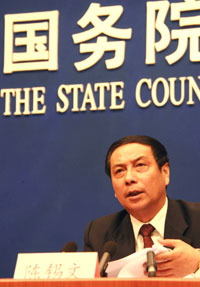 Chen Xiwen, director of the rural work office of the central government, answers questions from reporters at a press conference in Beijing January 30, 2007. [Xinhua]  |
China's rural land is collectively owned and allocated to farmers in plots on 30-year leases. Farmers are not allowed to use the land as collateral for loans or to sell it.
Currently, some Chinese provinces, such as south China's Guangdong Province, have started trial sales of rights to use rural land.
Chen said that rural land traded on the market must have a construction authorization and must not be farmland.
Leasing land from farmers for construction purposes is now illegal, according to a notice issued by the Chinese government last September to tighten land supply.
According to the notice, transference of farmland for construction purposes must be in line with local land use projects and should be included in the annual land use plan.
Chen affirmed that China will continue its land-utilization reforms to control illegal sales of farmland and protect farmers' interests.
The issue of rural land rights is a thorny problem for China. Without secure land rights, more and more Chinese farmers have been cleared from their land to make way for roads, factories and residential areas as China's economy sizzles.
Chinese Premier Wen Jiabao warned earlier last year that illegal seizures of land without compensation and resettlement are a key source of instability in rural areas.
"This kind of thing sparks mass incidents in the countryside," said Wen. "We must absolutely avoid committing an historic error over land problems."
The central leadership has taken some positive steps in this regard. According to the notice issued last year, the use of farmland for construction purposes will no longer be approved by the State Council for each project, but should be reported to provincial governments and submitted to the State Council for approval on an annual basis.
The new rules put the responsibility for land permits on provincial governments, said Chen. That means that if local land use exceeds the quota, local governments will have to shoulder the responsibility.
China's reform of land utilization should reflect Chinese conditions and be
managed step by step, said Chen.
Top reason for farmers'
petitions
Land confiscation is the most frequent subject of petitions made by Chinese farmers, with complaints about village finances and environmental pollution coming next, he said.
Chen said that government officials "should not turn a deaf ear to farmers' requests".
"Neither should government officials brush aside farmers' petitions claiming that they are trivial," he said at a press conference held by the Information Office of the State Council.
Chen urged governments at various levels to "get acquainted with farmers' requests and endeavor to have their problems resolved".
He warned that if governments failed to address farmers' issues in a timely and efficient manner, a single petition could lead to "a mass incident" involving public protests or even a riot.
The number of "mass incidents" attributed to Chinese farmers declined last year and the numbers of those who died from such incidents or got arrested were also down, Chen said, without revealing specifics.
But chief judge Xiao Yang told a national judicial meeting earlier this month that "mass incidents" should be given additional attention because they have become a conspicuous problem that disturbs social stability.
The Ministry of Public Security said that 87,000 mass incidents were reported in 2005, up 6.6 percent on 2004 and 50 percent on 2003.
Although the central government has repeatedly underlined the significance of protecting arable land, some farmers are still losing farm land and not being sufficiently compensated.
The government didn't say what proportion of the farmers' petitions were related to land confiscation. But Chen said that the situation was improving as government regulations were implemented.
Citing a central government document issued in 2004, Chen said that compensation for farmers who lose their farm land must be increased and that local governments are also responsible for providing vocational training and re-employment services.
Under the document, the government would expand the social security insurance which now mainly covers the urban population to rural areas.
"All of these measures are gradually being implemented," Chen
said.
|
||
|
||
|
|