A-share market to be 'third largest'
By Xin Zhiming (China Daily)Updated: 2007-01-23 07:18
|
|
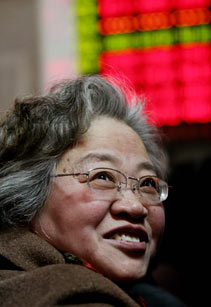

People would have been taken to be crazy had they forecast such a possibility one or two years ago when investors nearly lost hope in the bearish market.
But the tide has turned now. As the stock market continues to make big gains and touch historical highs, analysts are getting optimistic and it's more likely that they have the small investors to back them up.
The bold forecast was made by Hu Zuliu, general manager of Goldman Sachs Group (Asia), at China Capital Market Forum in Beijing on Saturday.
And he was not alone. Wu Xiaoqiu, director of Renmin University of China's Finance and Securities Institute, which hosted the forum, corroborated him, and said the Chinese market would become one of the biggest in the world with the best fluidity by then.
The performance of Chinese stocks, the second best in Asia last year has obviously fueled their high spirit. In four of the previous five years, they dropped, only to rise by 80 percent last year. This year, the stock index is largely on the rise despite some recent corrections.
Last year's boom was not accidental. A series of systematic adjustments in the previous years, when the market was in recession, laid the foundation for the rebound.
Regulators have made some headway in strengthening corporate governance of listed companies and their information exposure, Hu said. "Breakthrough has also been achieved in (introducing) QFII (qualified foreign institutional investor) and the share merger reform, which boosted investor confidence."
China launched QFII in 2003 and fine-tuned its rules last August, slashing the threshold to attract more overseas investment in its stock market. The combined QFII investment quota had exceeded $9 billion by last December.
Insurance funds were allowed entry into the stock market in 2004, bringing in more capital to the thirsty market.
"The bullish market has been built partly on the various sources of fund allowed in the market," said He Qiang, professor with the School of Finance, Central University of Finance and Economics.
A move of more far-reaching consequence came in 2004, when the State Council released the so-called "nine-point" guideline. It is committed to improving the quality of listed companies and plugging loopholes of the market, the main causes of investor detachment. Securities regulators soon issued a series of rules to implement the guideline to correct the problematic market.
In 2005, regulators cleansed the brokers market, disqualifying a number of brokerage firms that were embezzling investor funds and were guilty of other irregularities.
The most crucial step to reconstruct the market, none would deny, was the smooth share merger reform.
The reform, once a taboo for small investors, has proved to be a shot in the arm for the market because it has cleared the barriers for a smooth float of all types of shares. "It unifies interests of all investors, easing further reforms of the capital market," said Li Yongsen, professor with the China Youth University for Political Sciences.
The revised Securities Law and Corporate Law, enforced from January 1, 2006, gave the legal back-up for the market boom. A year of boom has ushered in a string of changes, including improved investor sentiment. More than 175,000 people rushed to open stock accounts in a week at the end of 2006.
But "don't be misled by the bustling world of money," warned Wang Zhongming, director of Research Center of the State-owned Assets Supervision and Administration Commission. "We still face many problems."
Weak market mechanisms and poor financing efficiency are factors worrying Wang, but they can be eased out gradually as the market restructures.
What can have a vital impact on the strategic change of the market is the return of some of the 320-plus major domestic companies, which have opted to list overseas, to the A-share market. "China must have its blue-chip market led by about 30 elite companies," said Ding Guorong, chairman of Shenyin and Wanguo Securities.
(China Daily 01/23/2007 page4)
|
||
|
||
|
|