Dish translations not so yum
By Li Qian (Chinadaily.com.cn)Updated: 2007-01-05 15:57
More and more foreigners become fond of Chinese food because of the wide variety and nutritional aspects of the cuisine. However, it's not easy for English-speakers to order in a Chinese restaurant. The Beijing Morning News took a closer look at restaurant menu items in a report on January 4.
It may be hard for some to imagine how the dishes "Ants Climbing Trees" and "Four Happy Meatballs" taste, but they are popular among Chinese.
A young Australian man told the paper he was shocked to see "Tiger Dish" on the menu while eating at a northeastern-style restaurant. "I thought tigers were a protected species. How can they serve tiger meat?" he said.
"Tong Zi Ji", a delicious chicken dish, literally translates to "Chicken Without a Sex Life" in some restaurants. Some netizens said that if the name were to be translated like this, "Rooster Without a Sex Life" would be more accurate.
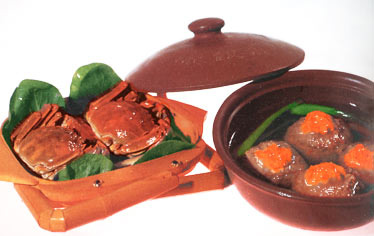 Stewed Crab with Minced Pork Balls, or Four Happy Meatballs literally translated from Chinese. [file]  |
The spicy "Kou Shui Ji", means "Mouthwatering Chicken", but was translated as 'Slobbering Chicken', disgusting dish photographer Xiao Mao.
Foreigners frequently encounter such awkward situations in China due to poor translations, which directly translate Chinese characters into English words.
Chinese food has a long history and a rich culture, which highlights the Eight Cuisines system. Many dishes are named after stories or beautiful fairytales.
"Menu translation should not be just simple and clear, but should also deliver pleasant feelings," senior food translator of Unitrans translation company Zhou Jinying told the paper. "For example, 'Hundred flowers', and 'Lotus' imply the beauty of the dishes which whets the customers' appetite, and should be preserved in their English names."
Others prefer more concise translations. "English dish names are for the convenience of foreigners and they don't necessarily need to be responsible for spreading Chinese culture," a professional translator surnamed Wang said.
According to legend the famous "Fu Qi Fei Pian", or "Husband and Wife Lung Slices" got its name from the customers of a small restaurant run by a couple. Another dish "Fo Tiao Qiang" or "Buddha Jumping the Wall", got its name from a poem a customer wrote, claiming the dish to be so delicious that upon catching a whiff of it, Buddha would toss his sutra aside and vault the wall surrounding the restaurant to get some. Still other restaurants name the dishes after the ingredients, such as abalone, shark fin and fish maw.
Yan Jie, who lives in New York, told the paper that locals have no difficulty in ordering at Chinese restaurants, as most of the English names of dishes are easy to understand. For instance, "Yu Xiang Rou Si", literally means "Fish-Flavored Shredded Pork" and is called "Shredded Pork in Garlic Sauce".
Other dishes are given unique names in the U.S. "Gong Bao Ji Ding" is known as "Kong Pao Chicken", even though "Kong Pao" doesn't mean anything.
Fortunately, the authorities are doing something to tackle this annoyance. By the end of January 2007, all dishes and drinks served in Beijing's restaurants will have standardized English names, according to the Beijing Speaks Foreign Languages Program, which will make it just as much of a pleasure to say the names of the dishes as it will be to eat them.
|
||
|
||
|
|