'Serve the media, not manage them'
By Qu Yingpu and Zhao Huanxin (China Daily)Updated: 2007-01-04 07:15
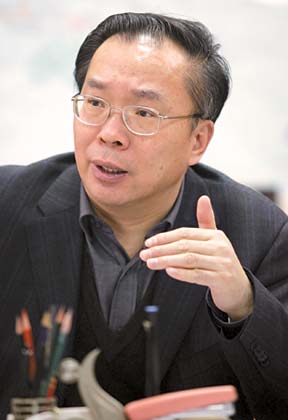 Wang Guoqing: facilitating overseas journalist[Photo by Xu Jingxing] |
Government officials are being urged to fully cooperate with foreign journalists, who are flooding in to quench the thirst for information on China with the Beijing Olympics round the corner.
Compared to the longstanding practice of "managing the media", governments at various levels are preparing to serve, instead of shying away from, journalists, following a new regulation which took effect on Monday.

"In the relationship between government and the media, we are promoting a shift from managing the press to serving it, treating reporters as 'clients'," Wang told China Daily.
From this year, government information offices throughout the country are implementing a reporters' assistance project, designed to help international media by compiling information about the people and places they may want to cover, and providing logistics services, he said.
The idea is to have each region come up with a general handbook for overseas reporters and produce special pamphlets for any projects that are of interest to journalists, he said.
The project also requires foreign affairs departments at the provincial or local level to ease the way for the anticipated influx of overseas reporters by producing info DVDs, interpreters, travel tips and other logistical support, Wang said.
The official said his office requires government spokespersons as well as other officials to release "timely, accurate and newsworthy" information to reporters, try their best to be accessible and not deny interview requests.
The number of overseas journalists is expected to rise sharply this year now that the new media regulation which gives unprecedented access to overseas media is in effect.
The rule prescribes that foreign journalists need only the consent of people or
|
So the key point is how the international media would portray a true China image. Wang Guoqing |
Estimates about the number of overseas journalists visiting the mainland this year are not immediately available, but Wang said at least 30,000 are expected during the Games next year.
However, Wang cautioned that while overseas reporters may not have any difficulty reporting in Beijing, he was "not quite optimistic" about the implementation of the rule outside major cities, where the news release and spokesperson system is just beginning to take shape.
The officials there are used to the management scheme set up 16 years ago, he said, referring to the Regulations on the Supervision of Foreign Journalists and Resident Foreign News Organs, enacted in 1990.
They are encouraged to discard the previous mentality, and face the media in an open and honest way, he said.
"I will not be surprised if foreign reporters encounter some difficulties in obtaining news," Wang said. "Their Chinese counterparts, too, have similar experiences in some regions.
"But changes will take place because we are pushing for them."
In fact, better serving the media has improved government accountability and governance, Wang said, adding his office had been pushing for the establishment of a government news release and spokesperson system for local government for the past three years.
"We want spokespersons to be true 'insiders' of government decision-making and other affairs so that they can better fulfil their duties," he said.
Wang, who was a reporter himself for 25 years, said he has instructed spokespersons mostly government officials never to treat reporters as subordinates or adversaries, but as partners who will often challenge with pointed questions.
There are perhaps "100 advantages and not a single disadvantage" in dealing with the press in a friendly and frank manner, meeting their demands by providing authoritative information, he said.
"Besides informing the public, the media act as a watchdog of government activities," he said.
"We sometimes complain that some Western reports about China lack objectivity, but at times I'm afraid our nonfeasance could be one of the factors," Vice-Minister Wang said.
"If in the course or wake of emergencies, relevant authorities refuse to give, or can't give, timely information, how can you expect objective and reliable reporting?"
(China Daily 01/04/2007 page1)
|
||
|
||
|
|