CHINA> APEC Summit


|
CHINA> APEC Summit
|
|
Related
APEC seek to break Doha deadlock
(Reuters)
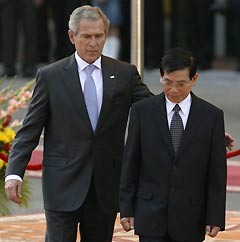
Updated: 2006-11-18 09:33 HANOI - Asia-Pacific leaders will pledge to break a deadlock in global trade talks as they open a two-day summit in Hanoi on Saturday that will also deal with North Korea and economic security threats.
That means opening up agriculture markets, "making deeper reductions in trade-distorting farm support by major players," and cutting industrial tariffs, "while dealing seriously with members' concerns and sensitivities." The leaders will pledge to "remain personally involved" to ensure negotiations resume and provide the "flexibility and ambition to secure a breakthrough." The Doha round of World Trade Organisation (WTO) talks collapsed in July, mainly due to an impasse over farm subsidies among six key players -- APEC members the United States, Australia and Japan, and the European Union, India and Brazil. U.S. President George W. Bush will also try to drum up support for a free trade zone encompassing the 21 APEC members, despite a rebuff of Washington's bid to make the proposal a key part of this weekend's summit in Hanoi. Supporters of the vast Pacific Rim free trade area see it as insurance against any inability to resuscitate the Doha talks. ECONOMIC SECURITY The week-long APEC extravaganza of plenary sessions, back-room meetings and banquets attended by 10,000 officials, businessmen and journalists culminates in the weekend summit at Hanoi's new, German-designed $270 million National Convention Centre. Indonesian President Susilo Bambang Yudhoyono told an audience of business leaders on Friday that economic security threats "are now very much a central part of the APEC Leaders' agenda." These threats include terrorism, the proliferation of weapons of mass destruction, pandemic influenza, corruption, and natural disasters such as tsunamis, earthquakes, forest fires, volcanic eruptions, floods and typhoons. "All these economic security threats require our region to work closer, and require governments and business to come together," he said. "It also requires us to start thinking and acting as a community -- a community with a shared future." A major terrorist attack or pandemic could deal a serious blow to APEC, which accounts for nearly half of global trade and nearly 60 percent of the world's GDP. |
沭阳县|
汶上县|
封开县|
民权县|
高青县|
建昌县|
宜兰县|
都江堰市|
双流县|
岳阳县|
图们市|
土默特左旗|
江西省|
长治市|
凤翔县|
建瓯市|
达尔|
夏邑县|
佛教|
珠海市|
承德市|
公安县|
沧州市|
邵阳市|
甘孜|
古田县|
曲靖市|
枣强县|
获嘉县|
聂拉木县|
苏州市|
炎陵县|
镇原县|
清苑县|
安龙县|
米泉市|
赤峰市|
桐城市|
齐河县|
西林县|
新龙县|