Japan's Prime Minister Shinzo Abe endorsed a 1995 apology by former leader
Tomiichi Murayama for the country's aggression in Asia before and during World
War II during parliament this week, his spokesman said.
Murayama issued a formal apology on the 50th anniversary of the end of World
War II on Aug. 15, 1995, in which he stated "feelings
of deep remorse" and "feelings of profound mourning" toward all victims involved.
"The prime minister indicated his view on the matter, no
more and no less," Chief Cabinet Secretary Yasuhisa Shiozaki said at a regular
press conference in Tokyo. "He made clear that as prime minister he will
continue" the stance established by Murayama.
In 1995, Murayama stated:
"Japan, following a mistaken national policy, advanced along the road to war,
only to ensnare the Japanese people in a fateful crisis, and, through its
colonial rule and aggression, caused tremendous damage and suffering to the
people of many countries, particularly to those of Asian nations... [I] express
here once again my feelings of deep remorse and state my heartfelt apology."
Abe also said "the last war brought pain to many Japanese and disasters to
other Asian countries and has left scars."
"It is a fact that the then leaders had great responsibility," he said.
On the San Francisco Peace Treaty, Abe said "as we accept the ruling of the
tribunal (of the Far East) under the San Francisco Peace Treaty, Japan would not
object to it in diplomatic relations."
Japan, China are closely
related
TOKYO - New Japanese Prime Minister Shinzo Abe said
Japan and China are closely related and strengthening bilateral political ties
is beneficial to regional and global peace.
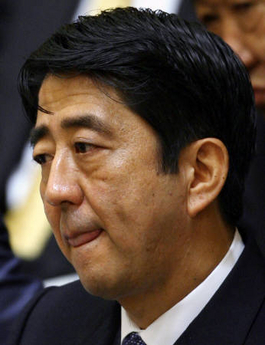
Japan's Prime Minister Shinzo Abe attends the
Lower House Budget Committee in Tokyo October 6, 2006. Abe will visit
China on October 8 and South Korea the next day for summits to repair ties
frayed by feuds over their wartime past.
[Reuters] |
Abe made the statement on Thursday during a session of the House of
Representatives Budget Committee, stressing the importance of relations with
China and South Korea.
Japan's economy is "inseparable" from these bilateral ties, and efforts
should be made to build "relations of trust" in economic and other areas, he
said.
He said frank exchanges of views, goals and ideals are the first step in
building "relations of trust."
Abe, who took office on September 26, will pay an official visit to China on
Sunday before flying to Seoul to meet South Korean President Roh Moo-hyun on
Monday.
Relations between Tokyo and its neighbours have deteriorated in recent years
because of former Prime Minister Junichiro Koizumi's repeated visits to the
Yasukuni Shrine, which glorifies wartime militarism. Those honoured there
include executed war criminals from World War II.
Abe has still not said whether he will visit the war shrine. But he has
reportedly been using softer public statements on history to lay the groundwork
for the summits.
He told a parliamentary panel on Thursday that wartime leaders, including his
cabinet minister grandfather Nobusuke Kishi, had "great responsibility" for
starting the war.
Kishi was imprisoned as a war criminal but was never tried and went on to
serve as prime minister from 1957 to 1960.
"As a result of starting war, many Japanese lost their lives and families,
and we left many scars on the people of Asia," said Abe, who, at 52, is Japan's
first premier born after World War II.
"Particularly those people in the position of leader at the time, including
my grandfather, had great responsibility."
Abe also referred in parliament this week to a 1995 statement by then-Prime
Minister Tomiichi Murayama apologizing for the wartime suffering Japan caused in
Asia.
And in a nod to an issue highly emotive in South Korea, Abe said he accepted
as valid a 1993 Japanese Government statement admitting the Imperial Japanese
Army forced thousands of mostly Asian women, many of them Korean, to provide sex
for soldiers.
Earlier, US President George Bush said he was encouraged by Abe's planned
visits to China and South Korea.
"The United States places utmost importance on close co-operation between its
two key allies in East Asia," Japan and South Korea, the White House said in a
statement released on Wednesday.
The statement also said co-operation between Japan and China helps in
"dealing with the common challenges we face in Asia."
