SINGAPORE -- U.S. Treasury Secretary Henry Paulson on Monday said on the eve of
his first official visit to Beijing that he will be patient in dealing with the
fast-growing country.
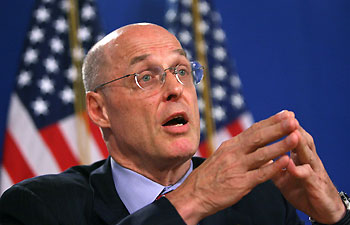
U.S. Treasury Secretary Henry Paulson speaks
during a news conference after G7 meetings in Singapore September 16,
2006. [Reuters] |
"I do care a lot about China
progressing with their reforms," said Paulson, who spoke to reporters in
Singapore. "I am not looking for immediate solutions or quick fixes to any
particular economic issue."
That's a message the former head of Goldman Sachs Group Inc., who begins a
four-day trip to China on Tuesday, has maintained while attending a gathering of
Group of Seven finance ministers and the annual meetings of the International
Monetary Fund and World Bank.
"This is a relationship that is very important to both our countries," he
said. "There is a good deal of interdependence." On Saturday, he told a press
conference that he was going to China with the intention of listening to
officials there.
At Goldman Sachs, Paulson visited China on numerous occasions, making key
contacts there. He said he would like to utilize that experience, but downplayed
expectations.
"We should not underestimate the fact that I'm wearing a different hat now,"
he said.
Since taking over the top Treasury spot in July, Paulson has been careful to
avoid statements that appear to put strong pressure on China, especially on the
sensitive issue of currency reform.
Paulson on Monday declined to say what he saw as an appropriate rate for the
yuan. He said, however, that "the strong dollar is clearly in our nation's
interest" and that it wasn't just China that needed to change.
"We've got a low savings rate and it is a problem in the U.S.," he said. "We
can do more there and we can do more on deficits."
Paulson spoke before the Commerce Department reported Monday in Washington
that the U.S. current account deficit increased in the spring to its second
highest level ever, reflecting a big jump in payments for foreign oil.
The deficit in the current account, the broadest measure of trade that
includes goods and services as well as investment flows, rose to $218.4 billion
in the April-June quarter, an increase of 2.4 percent over the first three
months of the year.
The shortfall represents the amount the United States must borrow from
foreigners to cover the gap between exports and imports.
So far, foreigners have been content to hold dollars in payment for U.S.
purchases of cars, televisions and foreign oil. Countries like China, Japan,
South Korea and Middle Eastern oil producers have for years been investing those
dollars in U.S. Treasuries, helping fund the deficit.
But the concern is what would happen should they and others decide they want
to hold less in dollar-denominated assets and more in other currencies, such as
the euro or yen, possibly sending U.S. stock prices and the value of the dollar
plunging and pushing U.S. interest rates sharply higher.
| 1 | 2 |  |
