Washington - Senior U.S. lawmakers urged Japan's next prime minister at a
hearing Thursday not to visit the war-related Yasukuni Shrine in order to
improve ties with China and South Korea, and also called for correcting the
history taught at the shrine's Yushukan museum.
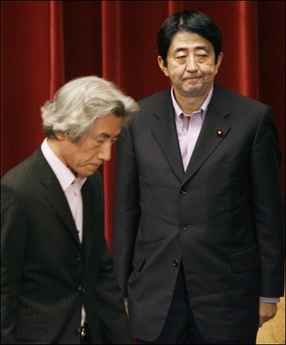
Shinzo Abe (R), the front-runner to be Japan's
next prime minister, has signalled he will adopt a tougher approach to
communist North Korea after replacing incumbent Junichiro Koizumi (L).
[AFP] |
Most vocal at the House of Representatives International Relations Committee
hearing on "Japan's relations with Her Neighbors" were the two top members --
Chairman Henry Hyde, a Republican from Illinois, and ranking Democrat member Tom
Lantos from California.
"It is troubling to those of my generation to learn that the Yushukan museum
in Tokyo is teaching younger generations of Japanese that the Second World War
in Asia was launched by Tokyo to free the people of Asia and the Pacific from
the yoke of Western imperialism," Hyde said.
"It should be corrected," he said.
The museum belongs to Yasukuni Shrine, which honors convicted war criminals
along with the war dead. Japan's ties with China and South Korea have soured due
to Japanese Prime Minister Junichiro Koizumi's repeated visits to the shrine,
especially this year on Aug. 15, the anniversary of the end of the World War II.
Lantos, a Holocaust survivor, slammed the Yasukuni visits by Japanese prime
ministers as "the most egregious example of Japan's historical amnesia," and
said they are like laying a wreath at the graves of former Germany Nazi leaders
such as Heinrich Himmler, Rudolf Hess and Hermann Goering.
"My message to the incoming Japanese prime minister is very simple: Paying
one's respects to war criminals is morally bankrupt and unworthy of a great
nation such as Japan," Lantos said. "This practice must end."
Lantos also strongly criticized the Japanese government for approving
textbooks which he said "deny the Rape of Nanking in China and imply that Japan
was simply trying to protect other Asian nations from imperialism by launching
World War II."
"Japan's failure to deal honestly with its past does great disservice to the
nation of Japan, offends the other key players in Northeast Asia, and undermines
America's own national security interests by exacerbating regional tensions,"
Lantos said.
James Leach, chairman of the committee's Asia and Pacific Subcommittee, said
the conflicts over history and the negative regional dynamics they can engender
"should be of concern to Washington" as the issue "renders problematic the
prospect of cooperation between the United States, South Korea, Japan and China
on a range of important issues, not the least of which is the North Korean
nuclear challenge."
But noting there are signs of efforts to improve ties after Koizumi's
successor takes office later this month, the Iowa Republican said, "Whether
these diplomatic initiatives prove durable or are evanescent, however, will
depend much on the political will of leaders in Tokyo, Seoul and Beijing."
Testifying before the panel, Michael Green, former senior director for Asian
affairs on the White House National Security Council, expressed a positive view
about Japan-China ties after Koizumi's successor, expected to be Chief Cabinet
Secretary Shinzo Abe, takes office.
China has criticized Koizumi but "not tried to box in his expected successor,
Shinzo Abe, with specific demands or conditions for summits," Green said.
Abe has expressed for his part a readiness to stabilize ties with China and
South Korea, and is expected to make the two countries the destinations of his
first foreign visits, he said.
Against this backdrop, Green said it would be "tremendously
counterproductive" for the United States to attempt official brokering between
Japan and China on the history issue and to try to strike a balance between the
two nations.
Green recommended such U.S. roles as making clear that U.S. interests are not
served by tension in the Japan-China relationship, challenging Japan to explain
its strategy for improving relations with China, and setting the stage for their
cooperation on issues such as energy and the six-party talks on North Korea's
nuclear program.
On South Korea, Green said the United States "can probably afford to be more
proactive because both nations are allies and share our values and because the
underlying strategic sources of tension are not as deep or enduring as they are
between Japan and China."
