Time passes. The relevance of contemporary life pushes the events of the past
out of the spotlight and into the shadows.
|
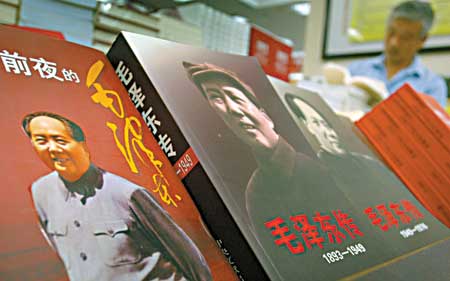
Books on the life of Mao Zedong
line the shelves of a Xinhua Bookstore in Nanjing, Jiangsu Province, on
the eve of the 30th anniversary of the Chairman's death. [China
Daily]
|
But when the people lose their
historical perspective, it falls to historians and other academics to make sure
the candle of great contributions continues to burn.
Saturday is the 30th anniversary of the death of Mao Zedong, who founded the
People's Republic of China on October 1, 1949 and led the nation for 27 years
after that.
Mao born on December 26, 1893 in Shaoshan village of Xiangtan County, Hunan
Province is often lauded for uniting China after decades of misrule and
internecine warlord rivalry, defending China's independence, and promoting
sexual and social equality.
Some foreigners with more exposure to China view Mao in that broader
historical context.
"My view now is that Mao had an exceedingly penetrating understanding of
Chinese society and very high ideals for the creation of a self-sufficient
nation with a spirit of co-operation," said Judy Polumbaum, a journalism
professor at the University of Iowa, who first came to China in spring 1975.
"He was more farsighted than he is given credit for today."
Nancy Jervis, a cultural anthropologist who first came to China in the 1970s,
said: "I still credit the socialist era with building a stable economy and an
infrastructure upon which the present economy is taking off. Not enough people
understand this."
Sidney Rittenberg Sr, an American interpreter and scholar who lived in China
from 1944 to 1979 and worked closely with Mao, said the key to his relevance
lies with some of his ideas that are still critical to China's well-being.
"I believe that studying China during Mao's lifetime, carrying forward what
was valid in his teachings (like his powerful philosophy of 'Seek truth from
facts,' and 'Investigation and study') and eliminating the influence of what was
wrong," he said.
"This is essential for the continued flourishing of China and for the new
life and new culture that China will create out of the lessons of the past and
the confusion of the present."
But Tom McGrenery, a writer from London based in Beijing, said: "I didn't
know it (Saturday) was the anniversary."
McGrenery said his impression is that to the Chinese of today, "he (Mao) is a
hero, but in a very vague sense."
Richard Baum, a professor of political science at the University of
California, Los Angeles, said: "Most expats in Beijing these days are young
professionals and entrepreneurs who came of age long after Mao Zedong's death."
"For these latecomers, Mao's memory and mystique are not very potent no more
than a vague historical curiosity while the post-Mao reforms are a 'given,'
which they take for granted."
In an economic sense, he said, "the new culture of entrepreneurship and
self-enrichment has crowded Mao and Maoism out of the marketplace of relevant
ideas."
(China Daily 09/09/2006 page1)
