Growth of the country's working-age population will slow down and lead to
labour shortages, a leading expert warned yesterday after it was announced this
week that the number of Chinese aged 65 or above hit 100 million.
To sustain economic development, the country will have to shift from a
labour-intensive growth mode and cope with an ageing population, said Cai Fang,
a director of the Chinese Academy of Social Sciences.
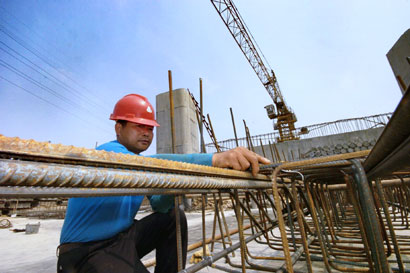
A worker works at a bridge construction site
in Changsha, Hunan Province in this May 22, 2006 photo.
[Xinhua] |
"Between 2005 and 2030, China's working-age population (those between 15 and
64) is projected to grow at 0.4 per cent a year, far lower than the global
average of 1.2 per cent," Cai said, quoting United Nations projections.
Coupled with the ageing of the workforce itself for example, those aged
between 50 and 64 will increase by 67 per cent the country will inevitably
witness a general shortage of workers, Cai, the chief of the academy's Institute
of Population and Labour Economics, told China Daily.
The mainland's population reached 1.306 billion at the end of last year.
Slightly more than 100 million, or 7.69 per cent of the total, were aged 65 or
above, pushing China into the ranks of ageing societies, according to latest
official figures.
The number of senior citizens will account for at least 10 per cent of the
total population by 2017, Cai said.
"As a result, the growth rate and the absolute number of the working- age
population will decline, which will lead to an inevitable labour shortage," he
said.
The working-age population was estimated at 918 million in 2005, or 70 per
cent of the total, according to Wang Guangzhou, a researcher with the China
Population Development Centre. That group is expected to account for 72.14 per
cent of the country's total and peak at 997 million by 2013.
From 2015, the growth rate of the working-age population will shrink
dramatically, Cai said.
A plentiful labour supply has long contributed to China's economic miracle.
At least one-fifth of the country's GDP growth between 1978 and 1998, for
example, was contributed by the migration of the workforce from agriculture to
industrial and services sectors, according to Cai.
The shortage of workers will result in an increase of wage bills for skilled
labour, which could erode China's comparative advantage in labour-intensive
industries, he said.
Factories are already finding it hard to employ migrant workers at low
salaries despite a contingent of 150 million awaiting migration from rural to
urban areas.
The change of labour supply patterns should prompt the country to change
economic growth path, for example, by developing capital- or
technology-intensive businesses, Cai said.
Bao Minghua, a researcher with Renmin University of China, said the increase
in labour costs as a result of worker shortage will not significantly affect
foreign investment.
"China cannot rely only on inexpensive labour to attract foreign investors,"
Bao said recently. "The increasing number of high-technology industries in the
country do not count on cheap labour."
(China Daily 09/01/2006 page1)
