A set of governmental measures to expose rampant illegal land acquisitions
took effect today.
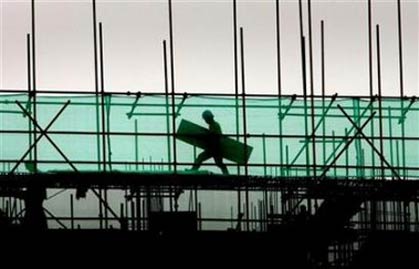
A
laborer works on scaffoldings at a construction site in Nanjing, China,
July 11, 2006. China on Monday released proposed rules to limit foreign
investment in real estate amid quickening efforts to cool off the surging
economy, an official news agency
said. [Reuters] |
The central government has required that commercial land should be bid and
auctioned nationwide. Previously, several provinces and municipalities had
employed such market-based practices.
The new regulations, released by the Ministry of Land and Resources,
stipulated that all land for business, tourism, recreation, commercial property
and other profitable purposes should be transferred through public bidding and
auctions.
"The process and final results of bidding and auctions should also be made
public," the ministry spokesman said yesterday. "Land transaction will be
transparent and be monitored by the public."
However, market-based practices in China are still in an embryonic stage. In
most regions, the government has transferred land through negotiation with
investors, which led to rampant corruption.
The ministry's statistics indicated that the government transferred 163,000
hectares of land nationwide last year, but only 35 per cent of it was dealt
through bidding and auctions. The ministry considered this an achievement,
representing an increase from 14.5 per cent in 2002.
However, the researchers blamed the ministry for its slow action in stepping
up the regulations.
"The government has regarded curbing fast land supply as a solution to stop
frenzied investment for a long time, but the concrete measures came out so
late," a researcher surnamed Lin with the Chinese Academy of Social Sciences
told China Daily.
The ministry's spokesman also acknowledged some irregularities in old
practices of land transactions. For example, some local governments withheld
information concerning the land, lay obstacles for some bidders and even use
underhanded deals to transfer land.
"The problems have existed for several years, resulting in some negative
effects," said Lin.
Lin cited corruption, a growing landless population, overinvestment and a
decline in the amount of arable land as already having challenged the central
government due to lax land management.
China had 122 million hectares of arable land last year, down from 130
million hectares in 1996. According to the ministry, it needs at least 106.7
million hectares of cultivated land to feed its theoretical peak population of
1.6 billion in 2030.
The central government has already realized the irregularities. Recently, it
urged the establishment of nine land inspection bureaux nationwide to strengthen
supervision of land acquisition.
Premier Wen Jiabao expressed concerns last week that too much land has come
to real-estate development, the transfer cost of land for industrial purposes is
still low and illegal occupation is still rampant.
"Much stricter measures must be employed to curb the
trend," Wen said.
Taxes proposed to ward off real estate crisis
A leading economist has proposed that the Chinese government collect property
taxes and real estate transfer taxes to rein in speculative investment and ward
off a possible financial crisis.
Owners should pay an annual property tax according to the size of their homes
and the government should collect transfer taxes to redistribute profits
generated by rising home prices, said Lin Yifu, director of the China Economy
Research Center of the Beijing University.
Since the government had adopted macro-controls over the real estate market
last year, increasing investment and price hikes had slowed slightly, but rising
prices in some big cities, imbalance between supply and demand and poor market
regulation remained.
Property was still seen as a sound investment in some circles, while a
combination of low interest rates and expectations of currency appreciation had
sucked in overseas money to China's real estate sector.
Lin told a seminar in Dalian, northeast China's Liaoning Province, that if
speculative demand continued, property prices would surge beyond the reach of
the vast majority of people and businesses, leading to a market bubble and
financial crisis.
(China Daily 08/01/2006 page2)
