China's lunar exploration project will invite more
international co-operation in its second and third phases, the project's
commander-in-chief said yesterday.
In addition, China calls for the peaceful use of resources from the moon and
beyond for the benefit of all people, Luan Enjie told an audience of about 300
Beijing college students.
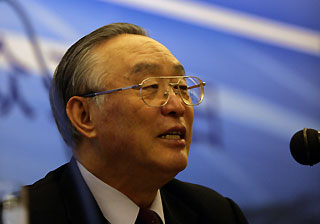 |
|
| Luan
Enjie: Nation catches up |
|
Although China is still in the "initial stage" in tapping the moon and outer
space when compared with the United States, Russia and Europe, the nation is
catching up, Luan said.
The first phase of the Chang'e Project was solely accomplished by China
through its own technology, products and designs, said Luan, former director of
the China National Space Administration (CNSA).
However, lunar scientists from Europe, the United States and Russia have
expressed their willingness to co-operate with China in its research of the moon
and deep space exploration, he said.
He noted it was a pity that he, during his six-year tenure as CNSA director,
had never "shaken hands" with his US counterpart of the National Aeronautics and
Space Administration (NASA), the world leader in space exploration.
The ups and downs in Sino-US relations as well as the fear on the US side of
leakage of space knowledge have hindered planned meetings between the chiefs of
two space administrations, he said.
On the query of when China will approve its second stage of the Chang'e
programme, Hu Hao, director of the Lunar Exploration Centre of the Commission of
Science Technology and Industry for National Defence, said: "It is still too
early to predict the exact approval date when research and arguments are still
under way among Chinese scientists."
The plan calls for three phases in the Chang'e Project before China launches
a manned lunar mission.
The first phase will send a satellite to orbit the moon, the second phase is
to conduct exploration on the surface through the soft landing of a detector,
and the third is to collect surface samples using a robot, which will then
return to Earth.
After landing on the moon, the soft landing device will automatically unfold,
and a narrow ladder will extend, allowing the rover to land on the moon's
surface, according to Ouyang Ziyuan, the chief scientist of the lunar
exploration programme.
Luan disclosed that about 20 universities and institutions are working on the
design of the lunar rover, but "no candidate design has been able to meet the
requirements of the lunar environment so far."
Many questions such as how to cope with the tremendous temperature
difference, which ranges from minus 170 C to 130 C, as well how to execute
navigation on the moon must be answered first, Luan said.
