The country's first satellite specially designed for seed breeding in space
will be launched into orbit in early September, it was announced over the
weekend.
|
 |
|
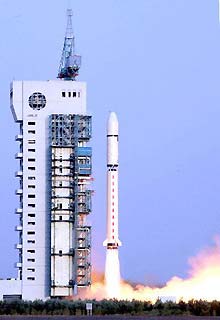
A
file photo shows the Shijian-7 satellite lifted by Long March 2D in
Jiuquan satellite launch center on July 7, 2005.
[Xinhua] |
The satellite will be in orbit for two
weeks before returning to Earth, space officials said at a conference in Beijing
on Saturday.
Shijian-8 is expected to carry at least 2,000 varieties of plant seeds in
nine categories, including grains, cash crops and forage plants, as well as
seeds of fungi and molecular biomaterials that have been sequenced.
Sun Laiyan, chief of the China National Space Administration, said the "seed
satellite" will enable scientists to try and cultivate high-yield and
high-quality plant varieties.
Exposed to special environment such as cosmic radiation and micro-gravity,
some seeds will mutate to such an extent that they may produce much higher yield
and improved quality, said Sun.
Space experts said 40 per cent of mutated space seeds can be used in space
breeding experiments.
Since 1987, nine Chinese satellites and several of China's six Shenzhou
spacecraft have carried seeds for experiments and a number of new species of
plant seeds have been bred in space, but never before has the country launched a
satellite exclusively for seed breeding.
By last October, China had approved large-scale plantation of 43 species of
space seeds.
Space seed breeding centres have been established in regions such as Beijing,
Shanghai and Heilongjiang Province, according to the Chinese Society of
Astronautics.
Liu Luxiang, director of the Centre for Space Breeding under the Chinese
Academy of Agricultural Sciences, said that between 2001 and 2004, space-bred
rice and wheat varieties developed by his centre had been planted in about
566,600 hectares, producing an additional 340,000 tons of grain.
Experiments have shown that the vitamin content of vegetables grown from
space seeds is 281.5 per cent of that of ordinary vegetables; and microelements
of ferrum, zinc and carotene are also higher than normal.
