Deputy director of China's Ministry of Finance Lou Jiwei
says farmer immigration to urban areas is a solution to quell China's widening
income gap between rural and urban regions, reported chinanews.com on June 20.
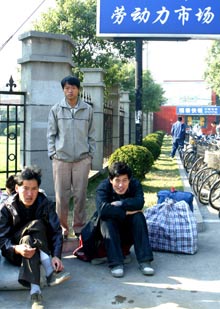
Migrant workers stay outside a job market in
Ningbo. [newsphoto/file] |
His comments came just days after research conducted by the ministry found
the income gap among Chinese farmers and urban dwellers is widening.
"The mobility of people is a good way to cope with the grave situation, and
the government needs to eliminate the obstacles to farmers' immigration," Lou
says, adding that China has to further reform its household registration system,
hukou, which results in a difference among farmers and city dwellers. Hukou are
assigned according to where someone is born, but are notoriously difficult to
change.
Lou says city dwellers take up most of the social welfare cash and as a
result there is not enough left over to support China's 750 million farmers. "It
is unfair for the farmers," says Lou.
The widening income gap, now reaching an alarming level, has been a special
concern for the Chinese government who has vowed to build a harmonious country.
The Chinese government has taken measures to tackle the problem by pouring a
large amount of cash into the rural areas.
"The government is expanding expenditure in the fields of education, health
insurance and social relief and aid to rural areas in order to insure fair
treatment for farmers," says Lou.
Data shows that China has a Gini coefficient of 0.46 between rural and urban
areas. The Gini coefficient is a measure for wealth inequality, with zero
indicating perfect equality and one representing inequality. A Gini coefficient
of 0.5 is an alarming level of inequality.
Commenting on the near-0.5 Gini coefficient, Lou denies it will wreak havoc
on China's stability, adding that the equality between the rural and urban areas
have led to the expansion of the coefficient.
Chinese cities and towns are expected to absorb about 300 million people from
rural areas in 20 years if the urbanization drive maintains a growth of 1 per
cent annually, according to previous state media reports.
According to data released this year, China has some 940 million
hukou-identified farmers, but only some 750 million still work the land. The
rest have left for the cities to try and find work.
