Buyers of big cars will fork out more tax while those who opt to buy smaller
models will pay less from April 1.
Consumption taxes on passenger vehicles with engine
capacity larger than 2 litres will be lifted to a maximum of 20 per cent from 8
per cent, the Ministry of Finance said on its website yesterday.
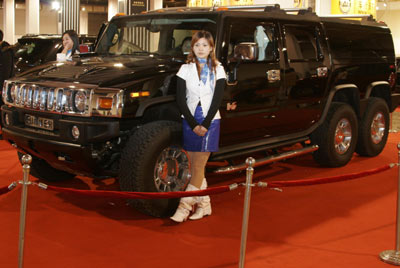
A Hummer vehicle is on display at a car
exhibition in Beijing in this photo taken on December 23, 2005.
[newsphoto] |
At the same time, levies on cars with engine capacity between 1 and 1.5
litres will be cut to 3 per cent from 5 per cent.
The changes are apparently to curb people from buying gasoline guzzlers, such
as sport utility vehicles (SUVs) and large sedans, and conserve oil in the
energy-hungry nation.
On Tuesday, the ministry announced that consumption tax would be levied on
oil products in a move to regulate and reduce energy usage.
The country's current Five-Year Plan (2006-10) lays great stress on energy
conservation and sustainable development.
Oil consumption by automobiles has been increasing rapidly as a result of
fast-growing vehicle sales China is the world's No 3 vehicle market after the
United States and Japan.
According to the State Council Development and Research Centre, a top think
tank, automobiles are expected to devour 138 million tons of oil a year by 2010,
accounting for 43 per cent of the nation's total consumption.
The proportion will jump to almost three-fifths by 2020, it said. In 2000,
the figure was one-third.
The research centre predicted that China's annual vehicle demand would reach
9.4 million units by 2010 and 18.9 million units by 2020, up from 5.7 million
units last year.
The new tax policy is expected to encourage people to buy economy cars.
Li Hangchen, a 30-year-old executive in Beijing, told China Daily: "With the
new tax, I will buy a 1.5-litre car, rather than the 2.5-litre SUV which I was
planning to. It will save me thousands of yuan."
Analysts said the tax change would affect automakers' product strategy.
"The change will mean the launch of more small cars in the coming years,"
said Jia Xinguang of China Automotive Industry Consulting and Development in a
telephone interview.
Partly in anticipation of the tax move, Tianjin FAW Xiali Automobile, an
affiliate of China's top vehicle maker First Automotive Works Corp, recently
said that it would launch nine new models within the next five years to be a
leader in China's economy car market. The company aims to double its sales to
400,000 vehicles by 2010 from last year.
The new tax policy drove down shares of manufacturers of SUVs and large
sedans.
For example, shares of Hong Kong-listed Great Wall Motor, China's biggest SUV
producer, tumbled 3.8 per cent to HK$4.45 (US$0.57) yesterday, the biggest
one-day percentage drop over the past six weeks.