We must continue to emancipate our minds and accelerate the reform
May 25, 1988
We are carrying out a thorough and extensive reform. Why? Because we have learned from the "cultural revolution" (1966-76). The ten-year "cultural revolution", together with the period dominated by "Left" errors, which began in 1957, caused us to waste twenty years. The period from 1949, when the People's Republic of China was founded, to 1957 was one of rapid development, but after that problems arose. I don't mean that in those 20 years we did nothing good; we did a lot of work and scored some major achievements, such as the development of the atomic bomb, the hydrogen bomb and ballistic missiles. However, the overall political situation was chaotic, and the economy either grew slowly or stagnated. Even after the Gang of Four was crushed, we remained for two years at a standstill under the wrong ideological guideline of the "two whatevers".
It was not until 1978, when the Third Plenary Session of the Eleventh CPC Central Committee was held, that a new and correct line was formulated, together with new and correct principles and policies. These can be summed up as the decision to build socialism suited to conditions in China. And if we are to build socialism, our fundamental task must be to develop the productive forces, shake off poverty, build a strong, prosperous country and improve the living conditions of the people. There is no such thing as poor socialism. Socialism is characterized not by poverty but by prosperity -- the common prosperity of all.
To expand the productive forces we must carry out reform and open to the outside world; there is no other way. We cannot continue to keep our doors closed as we did for more than twenty years. It is unanimously agreed that we should pursue the policies of reform and opening up, and this unanimity is attributable to the ten-year disaster -- the "cultural revolution" -- the lessons of which are unforgettable. Of course, different opinions arise in the process of reform; but the differences are not over whether we should carry it out but over how far it should go, how it should be conducted and how we should go about opening to the outside. This is only natural, and there is nothing strange about it.
There is a common saying in China that practice is the sole criterion for testing truth. Our practice over the last ten years has proved that the line, principles and policies adopted by the Party since the Third Plenary Session of the Eleventh Central Committee are correct and that we are right to carry out the reform and opening up. We shall not slow them down but accelerate them. We must continue to emancipate our minds and speed up the reform and the opening process. These two tasks will continue throughout the course of China's development. They will not be completed in three, five, eight, ten or even twenty years -- there is too much to be done.
The reform and opening must be carried out in the light of the particular conditions in each country, because countries differ from one another in many respects, such as their economic base, history, environment and neighbours. We can study the experience of other countries but never copy them. In the past, we indiscriminately imitated other countries and suffered greatly from the consequences. Therefore, China can only build a socialism adapted to conditions in China.
The issue of Taiwan is yet to be resolved. China will eventually be reunified. Whether reunification can be brought about smoothly will be determined by two factors. One is how well the "one country, two systems" formula works in Hong Kong, and the other is how well we can do in developing the economy. In short, the solution to all our problems lies in economic development.
(Excerpt from a talk with Milo Jake, General Secretary of the Central Committee of the Communist Party of Czechoslovakia.)
(From Selected Works of Deng Xiaoping, Volume III <1982-1992>)

- China issues guidelines to develop 'all-for-one' tourism demonstration zones
- Torrential rain triggers disaster in Southwest China
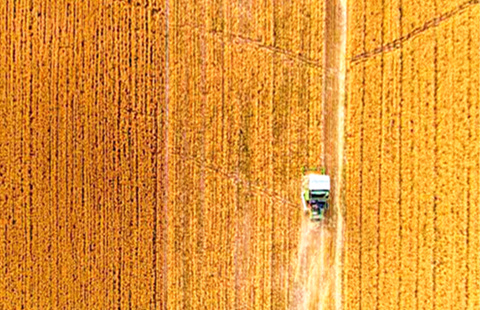
- Harvest time for wheat reapers in Shanxi
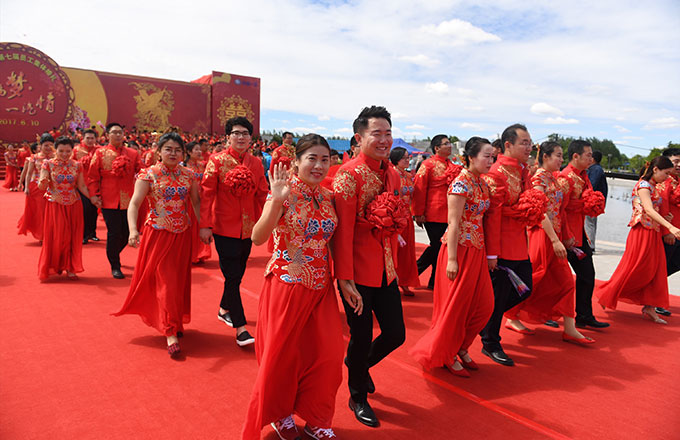
- Over 200 couples marry in Changchun group wedding
- Calligraphy tops other icons of Chinese culture, WeChat data shows