Comments
  Print
Print  Mail
Mail  Large Medium Small
|
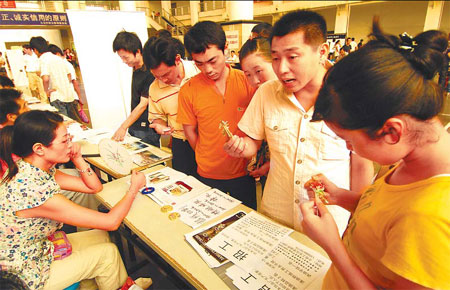
Workers ask about changing job conditions during a Sept 7 employment fair in Yiwu in East China's Zhejiang province. Factories in southern China have started to increase their payrolls as manufacturing orders grow. Asianewsphoto |
During the first half of this year, Yang Zongfu's blue jeans factory had few customers. Now, as his business picks up, he can't find enough workers.
Clutching a chalkboard with a long list of job openings, Yang joined about 30 other factory owners who have been spending their mornings at a street employment fair in the southern town of Xintang, the jeans manufacturing hub of China.
"I've been out here for two days and haven't found anyone," Yang said.
The dearth of workers is a surprising turn in an economy where millions were laid off just months ago, and the government worried that the jobless would riot.
The labor crunch is another sign that the Chinese economy - the world's third-largest - is bouncing back from the global downturn, invigorated by government stimulus spending and a flood of cheap bank loans.
But experts say the shortage is also the result of caution among migrant workers - whom the government discouraged from traveling to cities when jobs were scarce - returning before they are sure the economy has fully recovered.
China's economy has certainly begun to heat up, contributing to the increased demand for labor.
The nation's economic growth hit 7.9 percent in the second quarter, up from 6.1 percent the previous quarter, the government said. Exports, retail sales and factory output also improved in July, according to official statistics.
In Xintang, Yang said his business began improving in August when domestic buyers started placing orders.
His factory, which has received few overseas orders, is now ramping back up to its pre-slowdown headcount of 100 from around 60 earlier this year, he said.
His chalkboard "Help Wanted" signs advertised for one worker who can sew belt loops and another who can stitch pockets. He also needed a fabric-stretcher, a pants-hemmer and a zipper-stitcher.
Other factory bosses along the street displayed signs made out of red poster board or scraps of brown cardboard looking for textile workers.
Some economists and industry executives, however, said that the recovery was still anemic and may prove short-lived - signals that might discourage people from leaving the farms to return to the factories.
Andy Xie, an independent economist based in Shanghai, said that while factory orders were rising, they were still sharply lower compared with pre-downturn figures.
"What I see is that the retailers in the United States and elsewhere, in response to the rising cost of money last year, ran their inventories down to zero. So Chinese factories had no orders in October, November and December last year," Xie said.
"That was not a normal situation," he added. "Now with the credit costs pretty low again, you have restocking going on."
Although business has picked up, the orders are small in quantity, said Danny Lau Tat-pong, chairman of the Hong Kong Small and Medium Enterprises Association.
The association's members operate many of the factories in the Pearl River Delta.
Many workers are savvy enough to understand these business trends and are cautious about whom they work for because they might get axed again.
For many who returned home once they were laid off, spending the cash for a job search in a faraway province can be a big investment. Many don't want to risk it now if the prospects aren't solid.
In Xintang, migrant laborer Rui Deji scanned the help-wanted signs in the job fair as he clutched his lunch - a head of cabbage in a red plastic bag. The 20-something migrant worker with spiky hair, brown slacks and sandals said he had spent the past six years in textile factories in Xintang.
Rui said he had been unemployed for a month and would be willing to work for the average wage of 2,000 yuan a month. But he doubted that any of the factories would pay him that much for long.
"The problem is that business is unstable," Rui said. "You can't be sure the work will last for long."
Meanwhile, villages have started job-training programs and offered micro-loans to help migrants start small businesses at home.
Officials from Guangzhou asked the local government to tell migrants not to head to the Pearl River Delta, said Zhang Baoying, director of the Guangzhou Human Resource Market Service Center.
"We held meetings and advised the local employment authorities that the employment situation was going to worsen in Guangzhou," Zhang said.
"As a result, many of the workers, after learning about the situation through local officials, did not come back," he said.
AP
(China Daily 09/14/2009 page6)

 Night views of Harbin through the lens
 Tibetans take train home after pilgrimage or travelling
 World's largest shaftless Ferris wheel built in China
 Ancient cities to be connected by Xi'an-Chengdu high-speed railway
 Snow turns Harbin into winter wonderland
 Reed Catkin Festival held in Wuhan
 Is it a building or a bookshelf?
 First flight
 Polar icebreaker Snow Dragon arrives in Antarctic
 Xi's vision on shared future for humanity
 UN's top environmental honors go to three in China
 German trains collide near Duesseldorf, several people injured
 China beats Germany 7-4 in men's curling Olympic qualification
 Bayern beat Paris Saint-Germain 3-1 in UEFA Champions League


Copyright 1995 - . All rights reserved. The content (including but not limited to text, photo, multimedia information, etc) published in this site belongs to China Daily Information Co (CDIC). Without written authorization from CDIC, such content shall not be republished or used in any form. Note: Browsers with 1024*768 or higher resolution are suggested for this site.
License for publishing multimedia online 0108263 Registration Number: 20100000002731