Comments
  Print
Print  Mail
Mail  Large Medium Small
Sophisticated companies, when evaluating whether to participate in foreign markets, consider a number of factors in addition to the potential demand for their products in those markets.

Each foreign market poses different challenges with respect to the manner in which they protect the interests of their constituents.
These protections -- whether in the form of tariffs, taxes or the manner in which intellectual property (IP) rights are addressed -- are complex and can change over time.
When changes do occur, typically they reflect an increase in the burdens of doing business in the foreign jurisdiction.
Prior to 1996, under the patent laws of the United States, a company based solely in China could not be sued in the United States for patent infringement merely by making an "offer to sell" a product that infringed a US patent.
Instead, the risk of being sued in the United States for patent infringement arose only when a company made, used, or sold a product within the United States that infringed a patented invention -- or if the company imported any such product into the United States.
In 1996, however, the US Patent Act was amended to include as an act of infringement the preliminary act of making an offer to sell an infringing product within the United States.
This change was based in part on the reasoning that a patentee is harmed by an advertisement for a sale set to take place during the term of the patent.
Thus, conventional wisdom suggested conducting business through the use of independent distributors or separately incorporated (although wholly owned) operating subsidiaries.
Use of subsidiaries
Use of subsidiaries gained in popularity as they commonly take their direction from the corporate parent and only handle goods provided by the corporate parent.
In addition to a number of tax benefits, companies located outside of the United States relied on the increased difficulties a US plaintiff would face in forcing the parent company into court when it lacked any "presence" within the United States.
The plaintiff would have to proceed to serve the complaint on the parent company in accordance with the often time-consuming requirements of the Hague Convention On Service Abroad of Judicial and Extra Judicial Documents.
However, recent decisions have clarified that service need not always follow those requirements.
Under the Hague Convention, the provisions of service apply "where there is occasion to transmit a judicial or extrajudicial document for service abroad".
Serving a complaint or other document under the law of a given state within the United States does not necessarily require transmittal of the documents to the parent company.
The question of effective service sufficient to gain jurisdiction over the parent company then becomes whether, under the law of a particular state, it is sufficient to serve a foreign company's US-based representative or subsidiary.
Many states such as California allow a plaintiff to serve a China-based company by merely effecting service on a sales representative or operating subsidiary where the evidence demonstrates that it is reasonably certain that the person actually served would apprise the corporation of the service.
This does not mean that the China-based company is left without some protections.
To enforce the judgment in China, the internal law of China requires compliance with its internal service procedures under the Hague Convention, regardless of the procedures allowed by the internal laws of the United States.
If a judgment is not recognized in China based on the failure to comply with the exclusive means of valid service as authorized by the Ministry of Justice, the US-based plaintiff might be limited to enforcing any resulting judicial award within the United States.
Thus, the impact on the China-based company can range from negligible (where all transactions and operations are outside the US) to significant (where goods are exported to the US, and the plaintiff can seek an exclusion order from the International Trade Commission).
Chris Scott Graham is a Silicon Valley managing partner for the US-based international law firm Dechert LLP.
Editor's note: The IPR Special is sponsored by the State Intellectual Property Office and published by China Business Weekly. To contact the Intellectual Property Office, the IPR Special hotlines are 8610-64995422 or 8610-64995826, and the e-mail address is ipr@chinadaily.com.cn.
(China Daily 08/24/2009 page9)

 Night views of Harbin through the lens
 Tibetans take train home after pilgrimage or travelling
 World's largest shaftless Ferris wheel built in China
 Ancient cities to be connected by Xi'an-Chengdu high-speed railway
 Snow turns Harbin into winter wonderland
 Reed Catkin Festival held in Wuhan
 Is it a building or a bookshelf?
 First flight
 Polar icebreaker Snow Dragon arrives in Antarctic
 Xi's vision on shared future for humanity
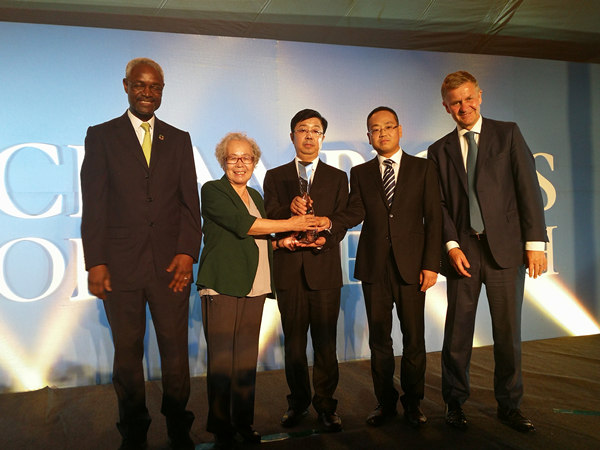 UN's top environmental honors go to three in China
 German trains collide near Duesseldorf, several people injured
 China beats Germany 7-4 in men's curling Olympic qualification
 Bayern beat Paris Saint-Germain 3-1 in UEFA Champions League


Copyright 1995 - . All rights reserved. The content (including but not limited to text, photo, multimedia information, etc) published in this site belongs to China Daily Information Co (CDIC). Without written authorization from CDIC, such content shall not be republished or used in any form. Note: Browsers with 1024*768 or higher resolution are suggested for this site.
License for publishing multimedia online 0108263 Registration Number: 20100000002731