

 Comments
  Print
Print  Mail
Mail  Large Medium Small
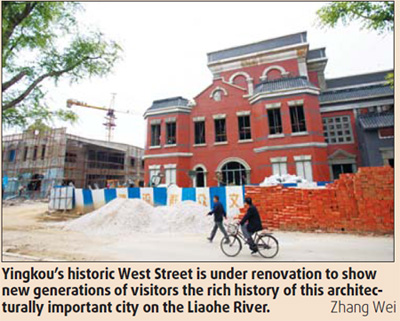
Traveling along the coastline of northeastern China's Bohai Bay, tourists can enjoy the rich mix of architecture reflecting the history and culture of the East and West.
The region's more famed centers of historical architecture are in Tianjin municipality, Qingdao in Shandong province and Dalian in Liaoning province.
But equally interesting, if lesser known, is West Street in Yingkou in Liaoning province.
The street is 1.6 km long on the southern banks of the Liaohe River.
Yingkou was once a ferry landing that became a prosperous port during the reign of the Qing Dynasty's Emperor Daoguang from 1820 until 1850.
After China was forced to open its doors to the outside world by the West in 1840, Yingkou became the first export trading port city of the three northeastern provinces of Heilongjiang, Jilin and Liaoning.
The harbor connected northern China with the world, and 11 countries established consulates in Yingkou.
West Street was soon a thriving center for harbor business.
Chinese merchants built and owned massive buildings that employed Western architectural elements such as terraces and Roman columns.
Banks, gold and silk stores, oil mills, herbal medicine stores, hospitals and tea shops were built on the busy street.
Business people from around the country stayed at West Street hotels to do business at local banks.
Large-scale construction projects slowed during World War I and finally came to a halt after 1931, according to local historians.
Sixty architecturally important buildings have survived, and about half have been carefully preserved to promote the history of the harbor city.
Big houses
One surviving legacy is that of the "da wu zi". Literally, the words mean "a big house".
In fact, a da wu zi was a business compound of hotels and warehouses, where merchants lived, stored goods, set up temporary offices and made deals.
In addition to accommodations, the da wu zi provided agent services for customs declarations, taxes, accounts and consignments.
Brokers opened businesses in the compounds to inform customers about market conditions and act as intermediaries on business deals.
Resident business people traditionally obeyed a strict ranking system that was in reflected even in what they ate.
Senior merchants living in VIP rooms ate rare and expensive rice. Middle-class guests would dine on a mix of refined and coarse food grains. Lower-class employees and apprentices ate steamed cornbread and pickles in kitchens.
Yingkou was home to some 100 da wu zi compounds with names like Yuxingsheng, Xingmaofu and Yishunkui.
One called Ruichangcheng boasted a three-story building of red brick completed in 1910 on West Street.
On the roof were watchtowers, which reportedly were used to defend against gangsters.
It reportedly cost 100,000 silver dollars to construct the building.
With a renovated white stone face, the building today resembles a fortress from outside.
Inside, a visitor is bathed in sunlight that penetrates a skylight above an inner courtyard.
Other West Street buildings have parapets, or low railings, on the roof.
Parapets were a style popular during the reigns of Qing Emperors Tongzhi (1862-1874) and Guangxu (1874-1908).
The parapet walls, if high enough, often looked like another floor of the building from street level.
Some historians have surmised that merchants who announced they would build a three-story building would resort to a tall parapet if they exhausted their budget after the first two floors.
Their ornate style led them to be hailed as "Chinese Baroque" parapets.
More buildings today are being renovated to grow commercial and tourism development as Yingkou works to restore the city's sophisticated history for new generations of visitors.
(China Daily 08/03/2009 page8)
 Night views of Harbin through the lens
 Tibetans take train home after pilgrimage or travelling
 World's largest shaftless Ferris wheel built in China
 Ancient cities to be connected by Xi'an-Chengdu high-speed railway
 Snow turns Harbin into winter wonderland
 Reed Catkin Festival held in Wuhan
 Is it a building or a bookshelf?
 First flight
 Polar icebreaker Snow Dragon arrives in Antarctic
 Xi's vision on shared future for humanity
 UN's top environmental honors go to three in China
 German trains collide near Duesseldorf, several people injured
 China beats Germany 7-4 in men's curling Olympic qualification
 Bayern beat Paris Saint-Germain 3-1 in UEFA Champions League


Copyright 1995 - . All rights reserved. The content (including but not limited to text, photo, multimedia information, etc) published in this site belongs to China Daily Information Co (CDIC). Without written authorization from CDIC, such content shall not be republished or used in any form. Note: Browsers with 1024*768 or higher resolution are suggested for this site.
License for publishing multimedia online 0108263 Registration Number: 20100000002731