Mainland grows into nanotech power
 |
|
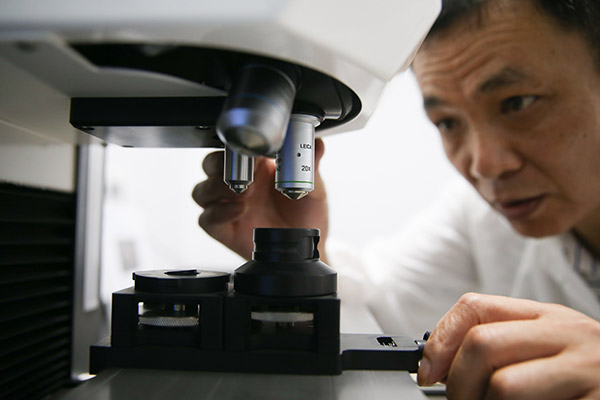
Wang Haowei, an expert in material sciences in Shanghai Jiaotong University, works in the lab. China's applied nanoscience research and the industrialization of nanotechnology have been developing steadily, according to a report. [Photo/Xinhua] |
BEIJING-China has become a nanotechnology powerhouse, according to a report released at the 7th International Conference on Nanoscience and Technology in Beijing recently.
China's applied nanoscience research and the industrialization of nanotechnology have been developing steadily, with the number of nano-related patent applications ranking among the top in the world, said the report.
The report was co-produced by Springer Nature, the National Center for Nanoscience and Technology, and the National Science Library, which is part of the Chinese Academy of Sciences or CAS.
According to Bai Chunli, president of CAS, China faces new opportunities for nanoscience research and development as it builds the NCNST and globally influential national science centers.
"We will strengthen the strategic landscape and top-down design for developing nanoscience, which will contribute greatly to the country's economy and society," said Bai.
Nanoscience is the study of the interaction, composition, properties and manufacturing methods of materials at the nanometer scale.
The science encourages integration of many disciplines and has a direct impact on daily work and life because it leads to the discovery of advanced technology.
In 1997, around 13,000 nanoscience-related papers were published worldwide. By 2016, the number had risen to more than 154,000, the report said.
The number of papers related to nanoscience from China grew from 820 in 1997 to over 52,000 in 2016.
Since 2007, the average compound annual growth rate of China's most cited nanoscience papers was 22 percent-three times the global rate, the report stated.
In terms of the number of nano-related patent applications, China has reached 209,344 over the past 20 years, accounting for 45 percent of the world's total.
In 2003, CAS and the Ministry of Education co-established the NCNST. Key to the NCNST's success has been the involvement of three of China's top research institutions-Tsinghua University, Peking University and CAS, said Liu Minghua, director of the NCNST.
Liu said that thanks to robust funding, a growing number of Chinese scientists have been attracted to research of nanomaterials. Additionally, more foreign-trained Chinese researchers have returned to China under favorable policies.
Energy nanotechnology and catalytic nanomaterials are the top two fields in which China has made remarkable achievements.
Faced with mounting public pressure to tackle deteriorating environmental problems, China is putting great effort into the research and development of new energy, as well as energy efficiency and environmental protection technology.
This has made energy-related nanotechnology a promising area, leading Chinese researchers to research batteries and energy storage and conversion, Liu said.
Catalytic nanomaterials research is considered China's most promising area of nanoscience. Nanostructure-based catalysts can speed up chemical reactions and could be useful in chemical industries and oil refining, experts said.
Bai said both challenges and opportunities await China.
More breakthroughs in basic nanoscience research need to be made, and the gap between basic research and application should be closed.
CAS will foster more young scientists who can innovate, accelerate the building of value chains, and foster broad and efficient international collaboration, Bai said.
"Through our joint efforts, we expect to apply nanotechnology to various sectors that will benefit the people and help China to be a global leader in science and technology," Bai said.